Showing posts with label JK Rowling. Show all posts

Friday, March 27, 2015

Censorship


Remember reading Ray Bradbury’s Fahrenheit 451 or The Diary of a Young Girl by Anne Frank in school? These are just two famous books censored for their content and watered down to fit the standards of the education system. 
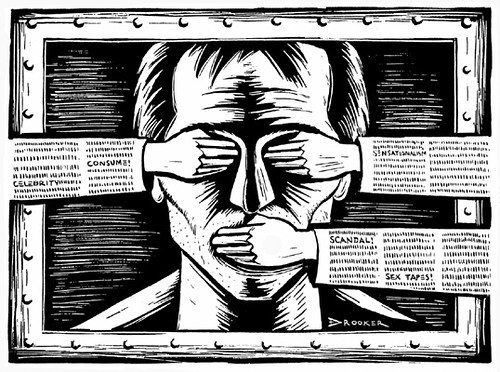
While some books don’t seem to be problematic to audiences, others might find problems and feel the need to ban it. In one famous case, some religious groups wanted to ban J.K. Rowling’s Harry Potter series. These groups claimed that it glamorized witchcraft and would influence their children’s minds. I think they forget the fact that it’s a fantasy book. The rally to ban or censor books just makes it easier for parents and teachers at school to avoid having a proper conversation about literary content. 

Books are here to generate discussion about culture, race and sexuality. It provides a platform to discuss history as it goes along with its literary content. In Mark Twain’s The Adventures of Huckleberry Finn, racial slurs are used frequently. 

Recently on a television show there was a discussion about whether they should ban Twain’s novel in Canadian classrooms. On one side people found that banning the book would not influence children to use racial slurs. On the other side people thought that reading the book would allow a discussion about the historical context and racism during the time.

Trying to ban books isn’t anything new. Back when Nazis occupied countries, they burned books and got people to do so too. Book burning events were there to keep people from reading novels which had ideas against the Nazi regime. With book burnings happening more and more back then, some history got lost and independent thinking went with it. 


To ban and censor books is a dangerous action. Whether a book has too much offensive language or has sexual content that doesn’t fit the heterosexual norm, it doesn’t mean that it should be watered down. Novels shouldn’t be censored or banned, instead it should be read and discussed with students. Teachers should generate discussions on the past history and how it connects to the book. Censorship hurts both the writer and the reader when content is deemed too controversial. Otherwise, banning books erases the history that goes with it and without talking about it, ignorance follows.

Tuesday, February 17, 2015

What is it about the writer's identity?


Re: "The World has a Mobile Size: My Canadian Passport is twice as Big"
by Kaziwa Salih
  

Kaziwa Salih raises some interesting notions about self- identity and how writing is part of the social web, whether it be the local or global community. Salih could have found examples in the theology of self-identity in work by Cooley and Nietzsche.

Cooley discusses a theory of “the looking glass,” which states that a person’s self grows out of society’s interpersonal interactions and the perceptions of others. It includes how as an individual one might appear to others, then imagining the judgement that people will place on that appearance, therefore creating a self-identity through the judgement of others.
Nietzsche, on the other hand, claimed that the individual crafts their own identity through self-realization and does so without relying on anything transcending that life—such as God or a soul.  

Salih's article expresses the strain of being an Kurdish in1991 in Iraq during the horrible dictatorship of Saddam Hussein. Salih discusses how she went through a process of finding her identity by including herself along with those who led the uprising that deposed Hussein .  
 “…Barham Salih, the former prime minister of Iraqi Kurdistan's regional government and a former deputy prime minister of Iraq's federal government. "Iraq, today, 10 years on from the war, from the overthrow of Saddam Hussein, is not what the Iraqi people hoped for and expected. We hoped for an inclusive democracy, an Iraq that is at peace with itself and at peace with its neighbors," Salih said. "To be blunt, we are far from that."

"But," he added, "it's important to understand where we started from. ... Literally hundreds of thousands of Iraqis were sent to mass graves. Ten years on from the demise of Saddam Hussein, we're still discovering mass graves across Iraq. And Iraqis are better off without Saddam Hussein…”


I think Kaziwa Salih would agree with the former Iraqi prime minister, considering her father that was often arrested on unknown charges that were based on his being Kurdish. She tells us how alarming it was realize the marks on his body that she had at one time dismissed, were vidence of torture.
Under Hussein’s reign, she had to give up music and a sense of identity with her Kurdish nationality. The identity of a writer is meaningful, especially when in publishing one's novels, and not only due to the decrease in sales because of having to place the title under multiple pseudonyms.
Examples of a struggle for identity dog well-known authors as well as the lesser knowns. For instance, JK Rowling is known for having to publish under a pen name. Or for another example The Help is about a very sensitive subject in the United States. In both cases there’s the element of struggle that is seen through reception of both texts.
When it comes down to it, it no longer matters about having your name written in the corner of the cover. As many of the not-well-known Kurdish writers know, it is about the words that you have torn from the very pit of your existence and let splatter against the pale pages to bleed as they may.