Monday, March 31, 2014

Living in a World of Writers

 When one wants to become a great and famous author, most of the time they simply see it as getting lots of money and becoming loved by their target audience. But what many don't see is that with every word a reader gets hooked on, with every page they flip, the writer is changing something inside the reader. Something that they will never forget, even if it's in the back of their minds, and this something will change them forever.
It can be anything from dreams, to worldwide dogmas. All from a turn of the page and an interpretation of the word. As a writer you must realize that not only are you creating entire worlds in your books, but you are building the foundations of entire peoples with every word they dedicate themselves to reading. You are capable of creating entire childhoods, precious memories, and fantastical inspirations within the minds of your readers whether you realize it or not. Don't believe me? Any child who has read and grew up with Harry Potter will beg to differ, as they wait every year for their letter.
However, it is not only the worlds of individual people you are building up, but in some cases entire practices dedicated to the text. Seems impossible? How about the one and biggest example known to the human existence for the past 1500 years? The Bible. Once written and translated over hundreds of different languages it's still is one of the most popular (and most stolen) books over a nearly two thousand year span. This piece of text has change not only the worlds of individuals, but the entire world itself! It has produced hundreds of branches of Christianity, influenced current day political structures and social norms!

Ha, so you believe me now? Great! Now let's blow some minds!
   

Friday, March 28, 2014

Maxed Out at Two Lines -- Horror Stories


One recent snow day, the intrepid students of creative writing who managed the trek into school held a Two Sentence Horror Story competition. Here are the results (posted with permission of the authors).

 The runners-up were:

It always bothered me that I never returned my grandmother’s brooch before she died. That is, until she came and got it herself.
--Dom Kent

“Jump in, Colin!” I ran toward the cliff and hurled myself off the ledge, staring at the pool of blood and organs that was fast approaching.
--Lynn Reicker

My brother never tasted chocolate before he died. Now I feed him some every day.
--Philip Drost

And the winner?

I never had any daddy issues, until I found his body in my bed….
--Jeremy Altman

Thursday, March 27, 2014

Omniscience and Limitation

"Omniscient" and "limited" are both totally equally valid points of view, but sometimes one will work better for a type of story or different style you want to pull off. Omniscient is usually paired with the 3rd person point of view whereas limited is usually paired with 1st person point of view. I'm not going to say you can't write your story in one or the other based on its genre or anything but there are certain techniques that could work better for you in one rather than the other. For example:

1) If you want a story where you really get to know the main character, limited will probably be better choice
Limited point of view will give you a close connection with your main character as the only thoughts being heard are from one character, not one voice among many. This also works really well when you use first person point of view with limited.

2) If you really wanna do some world exploration then I suggest using omniscient
By using multiple points of view you get to not only see different parts of your world but how different types of people react to it. Also with omniscient you are more likely to be getting the truth and in bigger pieces.

3) Writing in your own voice
If you and your main character are drastically different, it will most likely to be difficult to tell everything from their point of view as is expected with limited. In omniscient you are not taking the role of a character but as a person from the outside telling the story which you can do in any voice you want.

4) Controlling what the reader believes
I mentioned earlier that using omniscient can get you a more truthful account of what is going on but sometimes it can be fun having the reader jump to conclusions or keep them guessing based on what they think they know when the "facts" that they are dealing with are actually the protagonists views and attitudes.

I wish I knew why my boss chose to promote
Harold over me.
John was thinking about his stressful day.
Harold on the other hand was freaking out
because they all suddenly became
wooden marionettes.
             

What picture do your words paint?


“Writing is a series of choices.” It seems a little obvious does it not?  As sad as it may sound I had never really thought about it until it popped up while I was perusing the internet for advice. One simple imagery choice can alter how an audience views what we are trying to enact for them.  Our choices set the stage for the readers, brace them against their seats and can hurl them across the room at our keyboard stokes and pen smears.
              There is a great difference between repetition and redundancy.  Repeating images is an issue we all run into now and again. Even though we feel like we have found that one truly symbolic image that resonates, clinging onto it we can inadvertently kill the image. When writing and editing read over the lines with repeating images aloud a few times one after another. Does it sound like you have beaten the imagery in just for the sake of having it there? Or does each sentence create a new perspective on the image? Are you now simply skipping over the picture because it has bored you by the fourth or perhaps tenth time around?  
Clichéd images. We all dislike using them and reading them. So why are they so hard to avoid?  Is it that all the great symbols are taken or is it that we are too lazy to figure out new ones? Neither is true; every day we can paint something new with these recycled words and ideas.  Most of what we know now as clichés started off as stereotypes; however, somewhere along the lines of being used and re-used they misplaced their content and are now more often than not are simply skipped over.
Some tips for choosing literary pictures for your piece:

Does it feel clichéd? If so why does it feel that way? Is there a possible spin on the imagery?

Observe. Do not just say the birds soared for example, name the bird.  Was it a raven maybe it is a dove, truly think of that animal does it really soar or does it dart, maybe even dive?  What connotations do each of these birds bring with them? Is that the feeling you wanted?

Do not over paint, sometimes less is more.

Next time you are writing ask yourself this simple question: what am I painting?
              

Thanks to the University of North Carolina's Writing Center Hand Out on word choice for the opening inspiration. If you would like to take a gander at their helpful advice you can find the hand out here: Word Choice Hand Out 

Contests, prizes and periodicals, and why you shouldn't get discouraged by rejection

You’ve assembled your best work – maybe even written a brand new piece, and you feel pretty confident about it.

You mail it off with high hopes; certain it will wow the judges and could very well earn the top prize in the competition.

A few weeks pass, and you receive a big envelope in the mail. Enclosed? A big fat rejection letter, thanking you for your submission but telling you – in language somewhat more formal – that you stuff just wasn’t good enough this time around.

You are devastated, and feel discouraged from ever submitting a piece of your heart and soul to a writing competition ever again. What do they know, anyway, right?

Wrong. I did not paint this unfortunate – but extremely common – scenario in efforts to even remotely discourage anyone from applying to writing competitions.

Anyone who can call themselves a writer has at one time received their share of rejection letters. In fact, it is those who take the plunge and really force themselves to apply that many consider to be true writers; which means that while you shouldn’t be discouraged by a rejection letter, you should allow yourself to see past it – and learn from it.

With this in mind, I have compiled a list of the top local and national periodical contests open to everyone – and I encourage everyone to apply.

• The Fiddlehead: Canada’s longest running literary journal published four times a year at the University of New Brunswick sponsors an annual writing contest, with a total of $5000 in prize money to be won along with the chance to appear in The Fiddlehead spring 2014 issue.
• The Writers Federation of New Brunswick: The WFNB hosts an annual literary competition dating back to 1984. Prizes of up to $1500 are awarded every year, with open entry for New Brunswick residents.
• CBC Short Story Prize: The first prize winner of the CBC Short Story Prize through CBC’s Canada Writes receives $6,000, has his/her story published in Air Canada’s enRoute magazine and on the Canada Writes website, and will also be awarded a two-week residency at The Banff Centre's Leighton Artists' Colony. Runners up will each receive $1000.
• The Canadian Authors Association: The CAA offers a number of prizes up for grabs every year, including the CAA Award for Fiction (for “full-length English language literature for adults by a Canadian writer”), the Lela Common Award for Canadian History (for “historical nonfiction on Canadian topics by a Canadian writer”), the CAA Award for Poetry (“full-length English-language book of poems for adults, by a Canadian writer”), and the Canadian Authors Association Emerging Writer Award (for “a writer under 30 years of age deemed to show exceptional promise in the field of literary creation”).

So there you have it; while some of these competitions may be closed to 2013-2014 submissions, they are always gearing up for the next year – and you should, too!

That Unwanted House Guest We Just Don't Quite Know How to Deal With: Writer's Block


Does it not seem to be at an inconvenient point in the story that writer’s block decides to strike? It’s a real pain in the butt and it doesn’t help that when writer’s block occurs it can be difficult to deal with. Sometimes it starts at the very beginning of the process which makes getting started difficult or later into the story as you’re leading up to a particular section such as the crisis or climax. At some point or another we’ve felt the wrath and not to mention the frustration of dealing with writer’s block. So how do we deal with it? 

As a result of fighting against writer’s block on multiple occasions I’ve learned a few tricks that can help cope with it which I want to share.

1 Keep writing
This might seem a bit contradictory since writer’s block stops the flow of thoughts, but I recommend is repeatedly write the last word that you wrote down. It’s like trying to start that old lawnmower that won’t start right away. The more you keep writing that last word, he more you pull on the ignition chord. Eventually ideas will start to flow and you can continue on.

2 Skip forward and fill in the blank 
Sometimes you can have an idea of what your events are leading up to but there’s just that one section in-between that keeps driving you insane. By skipping ahead, you can temporarily push aside what’s bothering you. After writing a later scene it opens up some questions that ask what happened to the characters that brought them to this particular event. Creating these questions makes it easier to return to the previous section as they cause the writer to think about the situation and what they can do to lead into the events of the later scene.

3 Take a break
If all else fails, take a break. When you’re working on something for a long span of time, things can start to get confusing. What might seem to be going good could actually make no sense which can cause some confusion when the time comes for revision or even in general. So read a book, go for a jog, or take a nap. This is helpful as it gives yourself time to think things over or just give you some time to clear your head for a fresh start. 


Hopefully these tricks leave you feeling like this instead of:

These are my top three things that I rely on when I get writer’s block. Hopefully this works for you as well. There are also other ways to deal with writer’s block so feel free to leave thoughts and suggestions in the comments below. 
this

Sunday, March 23, 2014

Conflict and Desire

Today I'd like to talk to you about stakes.

The driving force behind any story is its cast of characters, particularly the protagonist. Every protagonist needs at least one goal for themselves, one driving thing that keeps them progressing through the plot no matter how grim things get and keeps the readers intrigued with their plight. The path to their goal will likely not be an easy one, but the harder the journey the more satisfying attaining their goal will be for everyone involved. Since I don’t know what your protag’s motivations are, let’s assume for the moment that all they want is a nice, juicy steak.
How badly do you want this steak!?
Make your protagonist’s goal something that your readers can picture themselves wanting as well. Inside all of us, there is a potentially explosive mixture of musts and must-nots, of needs and wants, of conflict and desire. Humans are contradictory and perpetually hungry creatures, but satisfying that hunger with the wrong things or in the wrong ways can lead to self-destruction. Conflict comes in many flavours, and one of my personal favourites is internal conflict. One must be patient in waiting for one’s steak to cook in order to enjoy it to its maximum potential. Don’t eat it too quickly or you’ll choke, and don’t add too many spices lest you find out at the least convenient possible moment that you're allergic.

What does your character desire? People who want everything are obnoxious, and people who want nothing can’t be related to. It’s safe to say a character who gets everything they want with minimal effort will be not only boring and unrealistic, but detested by pretty much everyone who reads their account. Whether your story is high fantasy or film noir, keep in mind the steak doesn’t have to be rare. They don’t need to be seeking jewels. Have you seen the price of video games lately? What’s something that you personally have wanted lately but could not obtain or one reason or another? What was the reason? Food is a good example of something everyone wants, and good food is something to topple kingdoms. And steaks are the prime example of this, if you’ll forgive the pun.

Whether or not their motivation is food, starve your character. They aren’t just hungry; they’re dying. A steak is in their sights and they must get to it. Make them have no choice in the matter. Not only do they want the steak, they’ll need it if they want to survive another day in whatever shitty circumstances they’ve found themselves.

Don’t be afraid to raise the steaks. I mean "stakes."

Friday, March 21, 2014

Editors: why you need one and where you'll find one PART 4/4

Editors: why you need one and where you'll find one
Kind of editor: Proofreader
Why you need one: After the book is hot off the press, you need a sharp eye to pick up on any additional errors, and quick!
Why people avoid them: "I'm sure with all that other editing and the publisher making adjustments, the book is fine. And I'm exhausted. And the book is so gorgeous. And I love my baby!"
Why people should stop avoiding them: This step will once again help you save money. First of all, if you can prove a mistake was made by your publisher (the ink is smudged, they had a line not centered, or they made a typo when transferring the work) you can get a lot of money back from the publisher. If it happens to be a mistake you made, then the editors can help you correct it so the audience won't make fun of you, or stop buying your work.
Where to find one: If you have a group of trusted friends and authors, you can finally let them have a hand with perfecting your craft. Most any English student will be able to spot these tiny mistakes without a lot of difficulty. However, if you can't trust any of the people in your life, or if they are no longer your friend because you ignored them while writing, you can follow any of the previous blogs' instructions as to how to find a proofreader. 

Thursday, March 20, 2014

The Technology of Language


Did you realize that, as you are reading this, you are using one of the oldest and most sophisticated technologies on Earth?  Language has transported humanity in ways that nothing else ever has. 

Calvin's cardboard box aside.

       At its most basic, it’s a way to tell each other such things as “I’d like a bagel, please” or “Your hair’s on fire”.  But it’s also the way in which we explore the world together, and make sense of the things around us.  Imagine how lonely life would be if you never communicated with another individual, or how awkward it would be to express your love to someone without language in any of its forms.  
We often take language for granted, as it has essentially always been a part of us.  When we speak or read, many of us are no longer aware of the process behind it.  But when it comes to writing, that transparency has to be stripped away, and we need to think critically.  There is a lot of minutiae in writing, like buttons on a spaceship.  Grammar, formatting, poetic structures–all of these were designed to make things better for the reader, but they can bring despair and torment to a writer.


Don’t be fooled by their happy faces.  Those giant grammar blocks are about to crush them.


       As writers, we tend to want to overlook the minutiae in favour of the meaning of things and the emotion, but a reader can’t get to that meaning if they are busy stumbling over misused commas or misspelled words.  It’s the role of the pilot to know everything about the plane; the passengers get to enjoy the ride.  Writers need to be aware of how words function, and this takes practice.  Language serves a distinct purpose, and if we choose to use it, we must aim at accomplishing something specific.  When people buy your work, they are going to expect it to do something, just as we expect calculators to calculate, and washing machines to wash.  
Language is a well-built technology, but it is also a complicated one, and learning to use it can sometimes be an agonizing process.  As with any technology, it is unwieldy at first, but, at some point, it becomes familiar.  With a little patience and perseverance, we can all skillfully operate this wonderful contraption.

Is Creative Writing In Your Future?

         Chances are you have already begun to ponder about where you will go once you leave this University and if you are anything like me, the idea of a postgraduate degree in Creative Writing (MFA) has crossed your mind. A degree like this is not extremely common, nor is it completely necessary in order for someone to work in the Creative Writing field. So, before you make any decisions, here are some pros and cons about the MFA in Creative Writing that you may want to consider.


PROS:

Community – many writers spend hours alone with a paper and pen or at their computer vigorously thinking and testing ideas. While this is a good way to work, writers need community and to be surrounded by other writers in order to improve and move forward with their writing. A postgraduate degree offers you this. You will be in classes with many others just like you who are willing to read and critique your writing in order to help you become better.

Exploration – while getting your MFA you will be introduced to people, ideas and world views that you may otherwise never get the chance to meet and explore. This could change you and the way you write, making you a better-rounded and educated person.  In today’s society it is important that we open our minds to as much diversity as possible, especially if we are going to write stories for the world to read.

CONS:

Debt – this is probably the most obvious downside to getting an MFA. Postgraduate degrees are not cheap and while scholarships are usually available, you are not guaranteed one. A postgraduate degree will not only charge you tuition, but if you choose to go away there will be travel expenses as well as living and eating expenses.

Risky – There are no guarantees with any degree. You could graduate thinking that a job is waiting right around the corner, when in fact you will be unemployed for years. Writers have an advantage as they can be self-employed, but even that is not an easy road. Writers with a BA can easily get a job that writers with a MFA are after, it is a competitive world.

                
        There are always going to be pros and cons that we as students need to weigh before making the best decisions for ourselves. It is good to know both sides and to be aware that nothing is guaranteed. An MFA is great for an aspiring writer, but you do not need one to write. On the other hand, if you want to teach this degree is usually required. Whatever you decide, wherever you go, make sure that it is giving you the best future possible.

Same old genre


As people we become attached and comfortable to and with certain things throughout our lives, as writers it may be more often than we'd like to admit. The best thing about the best writers is that they know their genre, as a writer and as a reader!

Here are some great subplots of great literary genres. Some of them I had never heard about!

Newbie writers (like myself) have a hard time 'knowing' our genre that well, and sometimes it can be all too easy to stick to one single genre that we have stumbled upon.

If all of your writing is science fiction set in a post-apocalyptic future of earth, how will you ever know if you can write a kick-ass fantasy thriller? Plus! Won't you get bored!?!?!?!

Sometimes it's just easier to stick within the borders of our favourite genre; it may not be the favourite, but rather the most accessible for us. The problem with accessibility to a genre is that we as writers can become complacent. Through complacency, boredom sets it.

That's right boredom.

You will get bored as a writer.

We will get bored as readers.

By writing in more than one genre, you can discover hidden talents that you may not have ever believed you could have!


Go read new genres! Go explore new blogs! So get out there!Run Wild and Free!
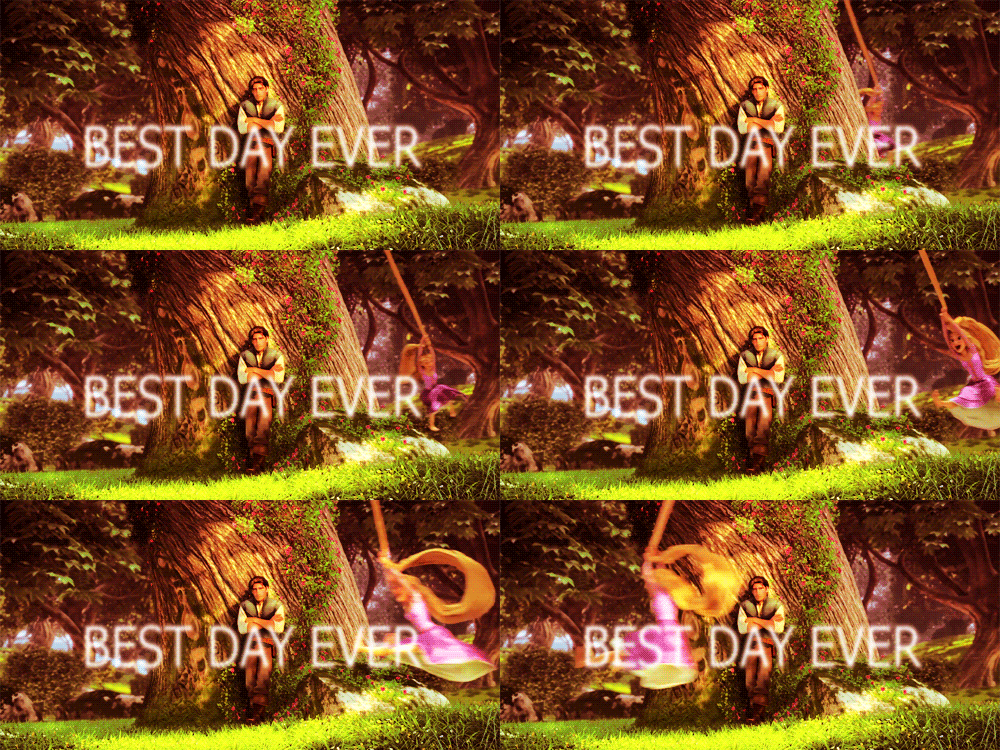
Have the best day ever!

All images and GIFS stolen from Google--if they are yours I am sorry.
Helpful blog HERE!

Wednesday, March 19, 2014

(Oh Na Na) What's My Name: Finding the Right Name For Your Characters

    Finding the perfect name can be tedious and frustrating, and when you don't know how to get started, a baby naming website seems like the logical place to start.
 But... if you spend a lot of time on those sites, you might start to get some weird looks.
http://www.reactiongifs.com/wp-content/uploads/2013/11/chkn.gif
"Are you having a baby...?"


     Luckily, the people at babynames.com know authors use websites like theirs for discovering names and have posted some tips just for us. I've picked some of my favourites to share with you.
One tip they give us is to choose a name by its meaning. They explain by saying "many writers give their characters names that have significance in the story". It is also suggested that a name could reflect the character's role in the story. The first character I thought of when I read this was Flynn Ryder from the movie Tangled.
"Ryder" is an English name that means Knight. Even if you haven't seen the movie, you can probably guess which role Flynn has.

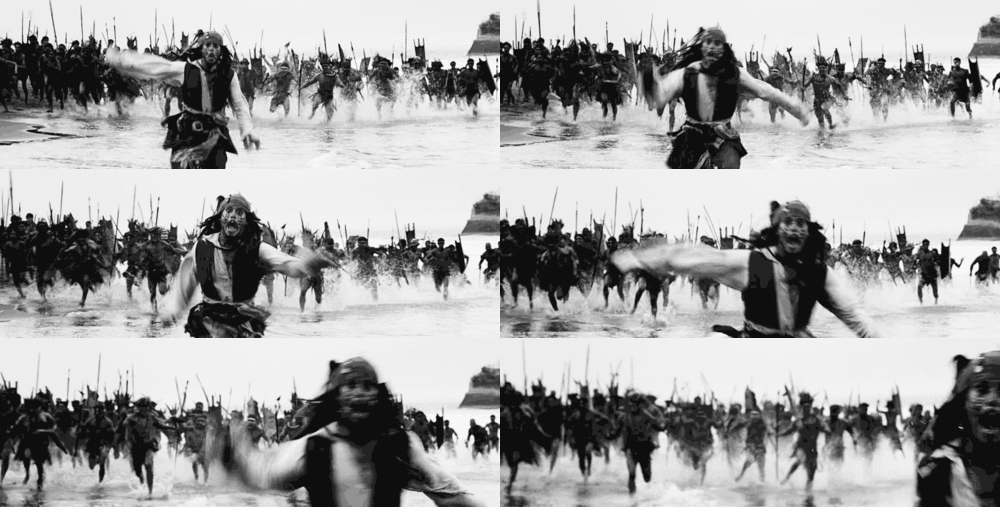
    Another great tip is to stay away from overused names. This is pretty straightforward. You stay away from certain names because everyone uses them. Baby Names use the name Jack as an example. "For some reason, every writer likes naming their hero JACK. I know it's a tough-sounding, honest-working name, but naming your hero Jack is like naming your son AIDAN. It's overdone".

That means you, Captain Jack! Run!

 The bottom line is to be more creative with your names.


Keeping with the theme of being more creative, the final tip I'm going to leave you with is this: have fun with names!  The original post suggests you start with your character's childhood nickname. This tip made me think of my favourite teen novel The Catastrophic History of You and Me by Jess Rothenburg. Her main character is named Brie (yes, like the cheese). This eventually leads to Brie's mentor, Patrick, calling her various nicknames such as Cheeto, Cream Cheese, and Cheesepuff. By using these fun nicknames, Rothenburg creates a dynamic between the two characters that makes their relationship more believable.
I hope this abridged version of the tips from Baby Names give you a great place to start!

There are tons more on the list. Here's the link: http://www.babynames.com/character-names.php

If you're a sci-fi writer, be sure to check out #4!

Editors: why you need one and where you'll find one PART 3/4

Editors: why you need one and where you'll find one
Kind of editor: Copyeditors
Why you need one: They are the pickiest people in the editing business! They will probably be the hardest editor an author will deal with, but often take the book from good to great. It's also important to note that not all copyeditors are interested in proofing prose and poetry, as most of them find employment with magazines and newspapers. They check your spelling, grammar, style, and usage. If there is a sentence that doesn't flow, it'll be worked out. If there is a sentence or words that can be dropped without changing the meaning of a sentence, the editor will get rid of it. These editors will also check your facts, so make sure you've done research on everything you've brought up in your book.
Why people avoid them: "They are killing my page count! All of these crossed out words and sentences have interrupted my flow and have changed the direction of my book! I have prefect spelling and grammar, and I don't need this type of help."
Why people should stop avoiding them: Money. If your book has even the slightest error and someone notices (they always do) your book is doomed. You don't want people to think you've pulled information out of your ass, and that they should mail you the latest copy of the dictionary to your “fan male” address.

Where to find one: For this one, you should ask fellow authors for recommendations, and seek people out on editors.ca. You do need to be careful when finding a copyeditor, as it is not uncommon for people to edit work for a second income. Just because a friend of a friend is an English teacher and edits papers constantly, does not necessarily make them a good editor. They may pick up on a few things, but don't understand what audiences are looking for. 

Monday, March 17, 2014

Editors: why you need one and where you'll find one PART 2/4

Editors: why you need one and where you'll find one
"MONEY MONEY MONEY."- Why every major author needs a substantive editor.
If you don't have an audience, you don't make money. 
Kind of editor: Substantive
Why you need one: Mainly for your audience. A substantive editor is able to step back from your story and the technical jargon, and look at your work as a consumer. They look at how your work is organized, how well it flows, if you are meeting style guidelines, and they should be able to give you feedback on how to make the work more appealing to your audience, and tell you if you have a best seller on your hands, or a mediocre work.
Why people avoid them: "They don't really know my audience. Besides, I don't really have a target audience. Whoever finds my book interesting will buy it."
Why people should stop avoiding them: You need a target audience, and if you don't know who those people are, you are in for heartbreak when no one values your work. You should write for you, but also for the people who are reading the book. A substantive editor can help you respond well with your audience and help you with advertising as well.
Where to find one: Even if you plan to self publish, send your work to a few publishers. A lot of editors from publishing houses know the consumer field and market, and will be happy to tell you whether or not your work will even sell. There is no harm in doing a little shopping around! You should also check with the Editor's Association of Canada (EAC) to find out when there will be substantive workshops. 

Saturday, March 15, 2014

Editors: why you need one and where you'll find one PART 1/4

Editors: why you need one and where you'll find one
Kind of editor: Developmental
Why you need one: For when you are just starting off. These editors are your go-to when you're on page 53 and you figure out that your character has a major defect that you just can't figure out how to fix, or when you figure out that your plot is bland.
Developmental editors can really help upcoming
authors map out the direction of their work.
Why people avoid them: Authors think they might change ideas because they know them even before they are put on paper. Their influence may mess with author creativity.
Why people should stop avoiding them: A developmental editor will not tell you what to change, and only make suggestions and be there for you to bounce ideas. They have an influence but it's rather positive. If they have to change your entire story it's a good sign the book is not worth your (or their) bother.
Where to find one: Often, developmental editors are freelance. Try a search engine to find hints of where to look locally, and ask local friends. Also, because developmental editors are often graduates of literature and creative writing degree programmes, check with local universities. 

Thursday, March 13, 2014

Who’s Afraid of Poetic Verse


Write a poem? Madness. I’ve never done such a thing. I don’t know how! I mean really, who isn’t a little bit afraid of the poetry monster? It’s a tricky form, but it’s not just for the highfalutin' poets of old. It can be for laypeople like us.  

One of the things that puts people off writing poetry so much is not knowing all the different possibilities out there. We get stuck with the image of Keats or Shakespeare and think that it needs to be this profound statement, written with prefect rhythm. As hardcore as that is, you don’t need to go that root. Yes poetry relies heavily on symbolic imagery and imaginative language, but can really be about anything.  
You’ll also need to figure out what form of poem you want to write, which needs to match up with tale you’re telling. That is, you’re not going to have a story, with a beginning, middle and end in a sonnet. Or a list of all the reasons you love someone’s smile in a ballad.
Here are a few of my favorite poetry forms and the sort of stories you normally find/you might want to attach to them. But remember there always can be good poetic reasons to bend the rules. 
Prose Poetry- Yeah, it’s a real thing and is exactly what it sounds like. Though it has the high emotion and imagery of the poem it also has the form and structure style of prose. Creative non-fiction can fall into this genre a lot/ There is no set subject. I would  recommend this to someone who is confident in prose but is new to poetry. It’s a nice way to dip your feet in.
Ballad- This is a story (or tall tale) written in stanzas and is sort of the next level up from prose poetry. In the sense that it’s not focused on an abstract emotion but is rather telling a narrative. This is usually done in rhyme and meant to be told orally. Think of it like a folktale you’d hear around a campfire.    
Free Verse- Anything goes. Lines breaks, rhyming, structure, all whatever you want it to be. Whatever you feel fits the poem you’re writing. This would be for someone that doesn’t like or doesn’t  know how to do the more structured ones like a sonnet.
Spoken Word- Does your poem make you feel like you want to scream from a roof top? If so spoken word poetry might be right for you. This is a poem that is solely meant to be read aloud and holds deep, sometimes personal meaning, to the poet. There is also a greater play and emphasis with the sound of words.  


Wednesday, March 12, 2014

What? (Subject Matter)

You decide to start writing a story, and right away you smack face-first into a wall. What should I write about? Sometimes topics come easily, but everyone has moments when there’s just a complete blank. It’s frustrating, but many things can be done to fix this.


     1. Inkshed. Set a timer, and put pen to paper for twenty minutes. The topic doesn’t matter. When time is up, read the results closely. Look at every sentence. Even a single word could be the spark that leads you to your story.

     2. Keep a small notebook with you at all times. Every time you come up with a possible topic, write it down. This way you won’t forget ideas, and when you can’t think of one there’ll be plenty waiting to be written about.

     3. Expand on a previous story, or re-write it from a different perspective. Look for stories you wrote when you were little and re-write those.

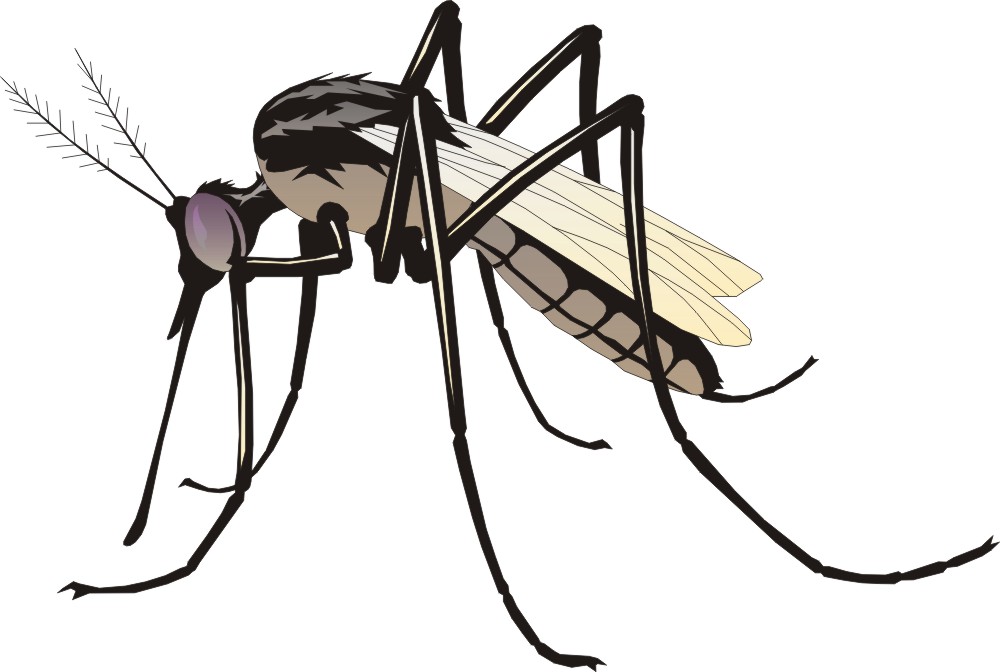
     4. Topics don’t always have to be extravagant. They don’t even have to be about people. Is there a moment you remember vividly, even though it’s seemingly unimportant? Perhaps you could write that moment entirely from the perspective of an animal, mosquito, or even an inanimate object.

     5. Think outside what you would normally consider. Pick random words and write about them. Potato. Helicopter. Fashion. What kind of story would include those things? With effort, almost anything can be made interesting to read, so don’t limit yourself.

     6. Take a break. While you’re doing other things, you’ll be thinking of ideas subconsciously.
Have conversations with people. Something they do or say may break you out of your slump. Ask people for ideas; they might think of something that would never have crossed your mind.


Where Am I?! Setting


When trying to create a story, your setting is one of the first things that you think about. Will this take place in the city or country? How about in a fantasy world with its own laws and rules? Does it take place in the past, present or future? The setting is one of the fundamental components that help create the foundation to a fantastic story.

The settings in a story can take the characters on a journey that helps shape and change the character.  The area around the character can affect them in many ways. An example of great use of settings is Game of Thrones. The story takes characters on journeys through numerous settings and locations, each with its own characteristics that set it apart from the others.

The setting also doesn't just mean the overall location at which the story takes place. Multiple secondary settings take place within a story as well Maybe one minute they are sitting at home, a nice normal day; the next minute they're in a mental hospital fighting restraints. Do your characters have a job? Do they go to school? Maybe your setting is even just the single room they're in.

Your setting should help reflect what type of story you want to tell with your characters. Give them a journey. An adventure. Tell a story with just your setting alone, and how time can change not just your characters but the places around them.

So. Where are you?

Tuesday, March 11, 2014

Uses and Abuses of Experience


            Writing a story can be easy if it is about your personal experience, like a memoir. You know everything that happened, you do not have to look anything up, or try anything new; just sit down and recall everything you can and put it into words. Some even write about their journey as they are having it. But as an author, why would you use all of your experienced parts of life, unless you were just going to write an autobiography? Yes, you can use your personal experiences for a character who goes through something similar to what happened to the author/yourself. Or you can change it up and add or subtract parts to make it more or less exciting. It all depends on what effect you are going for, but the problem with using experience is trying not to overdo it. You can abuse experience quickly if you are not careful.

When writing any kind of piece, you want to use experiences to help you write something more correct. One can write something completely imaginary but when doing so, one must make up everything and not just some parts, because then it will confuse the reader and they will not be sure on how this should be presented. But when you want to write something new, that maybe you have not experienced, it is best to research it or to try the part of the story you want to write. For example, you want to write a story about someone who is a daredevil. For one, you probably are not one yourself -- you might be, but not everyone is. So for the events you want the daredevil to present, you will need to go out and try some of them yourself. That way you are able to describe the feeling the character will have when they are doing these actions.

By always writing with experience, people can get bored with the same stuff all the time, because everyone has experienced school, a crush, rejection from friends, disappointment from parents…and so on, so by everyone writing almost the same stuff, no one will want to read it. Or even if you are an author and all you write is about one event that happened in your life, just with different characters and how they handled it, you will most likely lose your audience quickly.


This is the problem with experience, it can be great, and it can be terrible. You can never estimate the piece until the last word is written, so try for something different sometime; use research to write your piece instead of experience. We all need something different from time to time, so why not take the advantage that is given to us?

~Kelsey

Gettin' down 'n' dirty: promoting your work & yourself.

Promoting your work online—author websites, social media strategies, and the presence of book promotion through these mediums.


Use social media, just do it.

Not just Facebook. Twitter, Instagram, and Pinterest are excellent outlets for your writing, honest.

From experience, it's important to have your social media presence be known for something. When you think Tiger Woods, you think golf. Okay, you may think an assortment of things, but he is a public figure because he's darn good at golf. Whatever and however you promote yourself online make sure that you're making it very clear what it is you ARE. You're a writer and you want people to know it. Shout it from the rooftop.

 Facebook pages are great and an easy to spread the word around with your friends and family. It's also a window of opportunity to link non-friends your killer author website....(foreshadowing)

Get Twitter. It's not lame, it's not stupid, and it's certainly not pointless. If you are a real writer you will know that summing something important up in 140 characters (or less) is a skill, not a joke. It is, like Facebook, an important method of getting your website promoted sharing what interests you as a writer and really pushes your name and who you are. Getting followers is also easy as pie if you're on the ball. Follow those who interest you and post, post, post. Your time will come.

Instagram isn't simply for photos of food, bikes, and sunsets. You can totally market yourself and your writing through photos. Like Twitter, follow the hell out of people! Hashtag like crazy (only if relevant) and see where that takes you. Post photos of you at a book launch, or you and  your friends at a story meeting. Look involved and interested and people will also be interested. 

Pinterest. Ah, Pinterest. It's the most misunderstood of all platforms- but it's so dang easy! It has photos that link you directly to where you want to go, to a point of interest. Pin about books, authors, plays, movies, events and that will create a flock of followers who are also interested in the same things.  You have a book/essay/poem/story you want people to read? Pin it and people will read it. Make your image intriguing and those who matter will follow suit.

Social media strategies are really about finding who you are as a writer. Meeting real live humans who share your interest and who will most definitely become helpful to you and your writing in the future. There are so many ways to reach out to the creative community, don't be shy.


url.jpg


Here's some info graphics, because who doesn't like info graphics, on what you're doing right (and wrong.) 

  • http://socialmarketingwriting.com/

What IS an author website?


An author website is an online presence. A necessary tool for any writer. It not only showcases what work you have done (published or not,) but it may give an author bio, a what-to-look-forward-to for readers, and it's an all around great place to interact and express yourself and your talents.

It's important to keep these sites up to date if not people will become uninterested. Your website should and does reflect how much you care about your work. If you don't have anything published try posting  your unpublished work, drafts, and even book related events which you attend. Just keep posting. 


Two author websites worth checking out: One is much more complex, well funded, and detailed, but both do a good job at keeping readers interested & in the loop. Voila. 

  • http://www.jkrowling.co.uk/en_GB/

  • http://will-self.com/category/books/
url.jpg

hehe