I've always liked writing. Ever since I was a little girl, I loved to write. Even if I wasn't writing, I was coming up with ideas and telling people about them. Part of it was because I liked (and still like to) be the center of attention, but another reason is because I want to change the world with my ideas. Perhaps not in a huge way, but in a I've-made-your-day-better sort of way.
For class, the article I chose to read was titled The Girl with the Ribboned Pigtails. The title really stuck out to me and was enough of a reason for me to read it. I thought it was going to be more about the impression that this little girl left on our author, Shauna Singh Baldwin, and how this little girl then influenced her to write. Rather, Shauna met this young girl with ribboned pigtails and was left to ponder how easily people now-a-days can become published.
That's what's to gain from this article as a writer in the 'real world.' Now that we have access to the Internet as well as everyone trying to make it big through the world of publications, she hopes that this girl with ribboned pigtails will continue to write, possibly get published, and make a living through the means of writing.
Those who write should write because they like to write. They should try to get published because they want to get published and feel as though their work is good enough. They shouldn't write "Only when [they] son't have anything more important to do." Writing is important. That's what's to be learned from this. Writing is the centre of our world and needs to be taking seriously.
Showing posts with label creative writing. Show all posts
Showing posts with label creative writing. Show all posts
Friday, January 30, 2015

Thursday, December 11, 2014
What's in a Name?

"Nice to meet you wayward protagonist. Everyone around here calls me Grendel."
So you've got this idea for the next great Canadian novel, a truly staggering work of modernity that will change life as we know it and propel you to literary success. Before planning your Man Booker acceptance speech, you realize your entire manuscript is littered with gender neutral pronouns. After considering the potential of a post-modern masterpiece, you decide maybe it's time to go back to page one, and name some of these people.
But, but.. what about the fates of "Tall Child", "The Parent", and the beloved "Old Coot"? You're really telling me to delete all the "I's" in my first person narrative?
Well...yes.
Unless you have a really good reason for not telling us the names of characters, we're eventually gonna need some sort of identifiers to run with. By naming a character, we give it an identity; through identity we breathe life into the people/animals/hobgoblins in our stories. Remember that Heritage Moment? The one where Molly Johnson and Patrick O'Neill plead to keep their Irish names when they are adopted? The orphans want to keep their names because it's the only identity they have. Valerie Strauss of the Washington Post stresses the importance of what a name means to John Proctor in Arthur Miller's The Crucible:
To Proctor, his name is synonymous with his existence. Without a name he isn't worth "the dust on the feet of them that hang." This 'name' thing seems like a pretty big deal to the guy.As I pondered this on the way to work one morning, I remembered John Proctor in Arthur Miller’s “The Crucible.” Specifically, I remembered the absolute anguish of Daniel Day Lewis’s John Proctor from the movie version. Much is made, in literature classes, about Proctor’s refusal to allow Danforth and Parris to visibly show his name to the village as proof that he confessed.PROCTOR: Because it is my name! Because I cannot have another in my life. Because I am not worth the dust on the feet of them that hang! How may I live without my name? I have given you my soul, leave me my name!
So by taking in consideration the power of names, it's important to choose one that's appropriate. If you decide to name your moon wizard "Jesus," your readers will be bringing their own connotations to your writing. Is this wizard going to do something that may or may not be like another famous Jesus? Your telling me that your space pirate is just coincidentally named Ahab? If you aren't ready to answer these questions, it might be best to stay away from really obvious established names.

"No, you can't call me Yoshi."
Consider Joseph Heller's Catch-22. Yes, this is a guy that names someone Major Major, but also manages to have an incredibly unique name for his protagonist: Yossarian. I don't think I've encountered anyone other "Yossarians", and for good reason. It's a name that is wholly unique to the character, and would be more than a little off-putting to find someone named Yossarian in a spooky YA novel.
As writers, it is your job to make deliberate choices. Nothing should be coincidence or chance when you are creating, and the same goes for names. This was going to be the part where I go on a tirade about the meaning of characters names in Breaking Bad (Did you know Schrader is German for 'cutting off'?), but I'll spare you. What I was trying to get across through my tangent was that names brings into form the character we've created and define them, and are key components to storytelling. So if you decide to re-think your gender-neutral pronoun post-modern space opera, consider maybe calling your protagonist something like "Gregory."
Source:
The importance of a name (Washington Post)
http://www.washingtonpost.com/blogs/answer-sheet/wp/2014/09/19/the-importance-of-a-name/
(Yossi's April Congressional Mega-Article)
http://www.erepublik.com/en/article/-pcp-yossi-039-s-april-congressional-mega-article-2249841/1/20
What Would Jesus Do?. ethics,compassion,empathy,jehovah,watchtower,poetry,philosophy,atheism,animal rights
http://smmcroberts.net/ethics/wwjd.html
Thursday, November 13, 2014
Comma Comas in the Punctuation Nation
Welcome to the best and worst part about being a writer of any
kind – commas. They're one of the greatest friends anyone could ask for but, in
the same breath, they can tear us down as quickly as they build us up. Without
commas at all, we would eat Grandma for dinner rather than share dinner with
her instead. Without the Oxford comma, we would be inviting strippers, JFK and
Stalin rather than inviting strippers, JFK, and Stalin; however, keeping this
in mind, there can definitely be too much of a good thing.
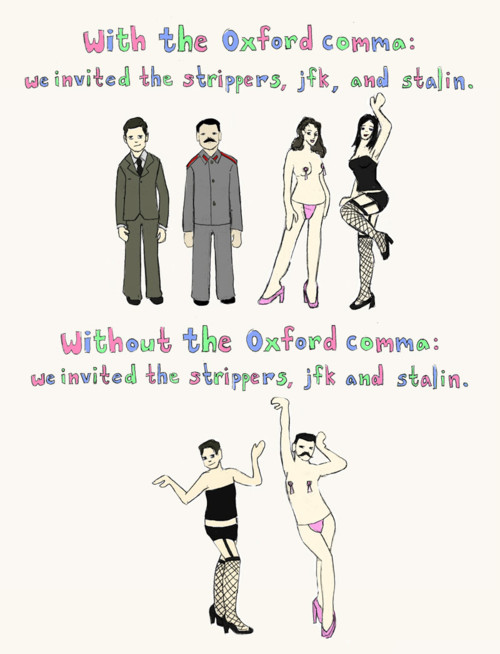
We
have the infamous run-on sentence. This
is when a person begins to write about an idea, continues on with it and, just
when it seems like the sentence is finally going to wrap up and finish, it
continues, making the sentence extremely difficult to read and leaving the
reader puzzled, bamboozled, and struggling for breath if they're reading aloud. This is a common issue with
writers for we become so entirely enthusiastic about our writing, and who could
blame us? Writing is an exciting thing and sometimes we simply get caught up in
what we're saying, forgetting to pause and gather our thoughts.
Myself
as a writer, I've found that – to avoid the terrible run-on – the easiest
solution is to break up my sentences and use 'comma substitutes.'
Take
the bolded sentence above for example. If we were to break it up in to chunks,
the end result could transform the sentence into:
This
is when a person begins to write about an idea. They continue on with it and,
just when it seems the sentence is finally going to wrap up and finish, it
continues. This makes the sentence extremely hard to read, leaving the reader
puzzled or bamboozled. Above all, it leaves them struggling for breath if
they're reading aloud.
Simple,
yet effective; however, another option is to use comma subtitles – hyphens and
semi colons as well as breaking up a sentence effectively – in order to destroy
unwanted, run-on sentences. An effective example of the use of comma subtitles:
This
is when a person begins to write about an idea. They continue on with and –
just when it seems the sentence is finally going to wrap up and finish – it
continues. This makes the sentence extremely hard to read, leaving the reader
puzzled or bamboozled; above all, it leave them struggling for breath if
they're reading aloud.
Using these tips and changing the flow of your
writing, you’ll avoid pesky run-on sentences, saving Grandma, and leave JFK and
Stalin off the pole.
Wednesday, November 5, 2014
What to Leave Out
“Leave out unnecessary details, unnecessary words, and things that you know nothing about.” This is what I was going to write in this blog post before I decided I didn’t want it to be boring and cliché.
Instead, I believe that there is a loophole in the topic that could take us somewhere interesting. “What to Leave Out” automatically makes us think about what to physically leave out of our writing. But what about the things that we should mentally leave out of our writing? In a lot of ways, the attitudes that we adopt have as much influence on our writing careers as our writing itself.
Everyone has their own personality and their own way of doing things, of course, but we do live in a culture where self-improvement is trendy; so, on that note, let us begin!
1. Leave Out Laziness
Nobody’s going to do your work for you, and nobody’s going to succeed for you. A creative career rarely happens by mistake. It requires strategy, diligence and inspiration. These things are interconnected, and I would say that all three are required if you want to reach your potential, but if you’re lacking in one of these areas (even just temporarily) the other two can likely still make a productive writer out of you. Yes, strive for all three, but don’t be discouraged when you’re not perfect (which brings me to my next point!).
2. Leave Out Pride
Pride is something that a lot of writers struggle with. This is not to say that a certain amount of pride should not be taken in one’s work, but it is important to keep an open mind and remain teachable. Thinking that your word is law is perfectly acceptable until you come across someone who actually knows better than you do. Receiving criticism from a place of humility is a lot less painful than having your pride hurt when you end up being wrong.
3. Leave Out Jealousy
Writing is a competitive business. Some will succeed, some won’t. It’s just like becoming a doctor, except more challenging. However, one thing that some writers (and people in general) do not realize is that jealousy is rather pointless.
First of all, it does not make you a better writer. Sure, seeing somebody else succeed can be a good source of motivation, but said motivation does not have to come from a place of negativity or jealousy. They should not be blamed for their success any more than you should be blamed for yours.
Secondly, some aspiring writers do not realize that when their comrades succeed, from that point on they know someone in the business. Instead of forming relationships and connections with their peers, they burn all of their bridges (or even neglect building them in the first place), which leaves them stranded alone on an island with no writing career and a whole lot of resentment.
 |
| He is not having fun! |
Tuesday, November 4, 2014
Speak to me: Dialogue
Ten years ago, I was part of a gaggle of excited undergraduates spending the last semester of our degrees in Tampere, Finland. Armed with (what we thought was) a magnificently flawless short film script, ready to shoot, we were lucky enough to take a class with an award winning screenwriter. He began by asking us to read the script. Halfway through the very first lined he barked:
“STOP! What does this mean?”
Sensing the issue to be based on the language barrier, we explained what those two words meant, literally.
“Yes! I know English! But what does this character mean when he says it?”
He continued to do the same for each and every word that each and every character said whilst each and every one of us wanted to knock his educated, pragmatic and successful Finnish head off of his shoulders. But he was right; dialogue is that important.
When the week of the script-writing genre recently dawned on our creative writing class, a collective hum of dread caused the classroom to throb. I eavesdropped on some of these fears being verbalized.
“I HATE trying to write dialogue!” one young lady spat.
“Urgh! I’m dreadin writing this script,” cried another.
I have always been intrigued how writers will willingly spill their emotional, secretive guts onto a page for forensic dissection, yet wilt into their shells when their characters are forced to partake in that thing we all do with each other every day.
First of all, I would advise writers who loathe this part of the process to avoid formatting until after they have gotten their ideas down on the page. Procrastination is always on hand when we feel lost and there is little else as tedious as grammar. Just spill. I have spent hours, days, weeks reading about script formatting whilst my pretty little ideas ran off, never to be seen again. Plus, a blank piece of paper doesn't have any inverted commas to play with.
Second, ensure that your characters can be differentiated from each other on the basis of what they say and more importantly, how they say it. If a scene has been workshopped and your colleagues know the characters, follow up the scene with nothing more than lines of dialogue. See if they can tell who said what. If they can’t, then they aren't fully formed (the characters that is, not your classmates.)
Third, let the dialogue reflect the story and not simply act to move the narrative along; let your dialogue entertain and intrigue. Don’t feel the need to explain everything that the character is feeling in a short line of dialogue, let silence, beats or fragments express an entire universe. Less is more. Take this exchange:
LISA
Hey Dan! Can I… About the other night? I…
ANDREW
Oh God! Yeah, no. Seriously forget about it.
LISA
Really! Oh thank God!
I actually heard that recently. Which is my final point. Never stop listening to how people talk to each other.
“STOP! What does this mean?”
Sensing the issue to be based on the language barrier, we explained what those two words meant, literally.
“Yes! I know English! But what does this character mean when he says it?”
He continued to do the same for each and every word that each and every character said whilst each and every one of us wanted to knock his educated, pragmatic and successful Finnish head off of his shoulders. But he was right; dialogue is that important.
When the week of the script-writing genre recently dawned on our creative writing class, a collective hum of dread caused the classroom to throb. I eavesdropped on some of these fears being verbalized.
“I HATE trying to write dialogue!” one young lady spat.
“Urgh! I’m dreadin writing this script,” cried another.
I have always been intrigued how writers will willingly spill their emotional, secretive guts onto a page for forensic dissection, yet wilt into their shells when their characters are forced to partake in that thing we all do with each other every day.
First of all, I would advise writers who loathe this part of the process to avoid formatting until after they have gotten their ideas down on the page. Procrastination is always on hand when we feel lost and there is little else as tedious as grammar. Just spill. I have spent hours, days, weeks reading about script formatting whilst my pretty little ideas ran off, never to be seen again. Plus, a blank piece of paper doesn't have any inverted commas to play with.
Second, ensure that your characters can be differentiated from each other on the basis of what they say and more importantly, how they say it. If a scene has been workshopped and your colleagues know the characters, follow up the scene with nothing more than lines of dialogue. See if they can tell who said what. If they can’t, then they aren't fully formed (the characters that is, not your classmates.)
Third, let the dialogue reflect the story and not simply act to move the narrative along; let your dialogue entertain and intrigue. Don’t feel the need to explain everything that the character is feeling in a short line of dialogue, let silence, beats or fragments express an entire universe. Less is more. Take this exchange:
LISA
Hey Dan! Can I… About the other night? I…
ANDREW
Oh God! Yeah, no. Seriously forget about it.
LISA
Really! Oh thank God!
I actually heard that recently. Which is my final point. Never stop listening to how people talk to each other.
 |
| "She doesn't sound very natural does she?" "She don't look it, either," |
Thursday, October 30, 2014
Making Memorable Characters
What’s this I hear about you wanting to make a memorable character? What have you got? Wait…wait did you say…a cynic who actually has a heart of gold? The books will literally fly off the shelves into people’s hands at that point. You also have a brooding bad boy; why are you only just now telling me this? Put him there next to all the others.
Cut.
Print.
Bestseller.
Enjoy the limelight, there’s a cocktail party at my house later.
It’s unfortunate that we live in the literary apocalyptic wasteland that is 2014, where just about every character archetype has been done to death and has faded into cliché. It forces up and coming writers to ravage the carcasses of other characters just to make their own, stitch two together and call it a new one. Think of it like Mad Max, except everyone’s a more financially successful writer than you are.
 |
| There he is kids. The sweaty, bloodstained author of The Maze Runner. Don't look it up; just take my word for it. |
Everyone wants their characters to have impact. On a smaller scale, we want them to mean something to somebody. We want our audience to laugh when they laugh, to cry when they cry or for the very least, feel for them as they do so. On a much larger scale, we want them to be remembered. We want what they say and what they do to transcend generations. We want to put pen to paper and scribe the next Tyler Durden but we live in world where we try so hard to be original that we forget all about the execution. You are Jack’s conscientious use of recycling.
Sorry to say, that we can’t make the next new character because they’ve been updated and reused time and time again. Instead of conveying originality to your readers, you should be convincing them that the people they’re reading about have a beating heart. Your character needs to know joy, they know to sadness, defeat, envy, hatred, loss. This is less about making something new and more about making something believable.
Put your brooding bad boy under the spotlight. What scares him? Who does he love? What does he love? Go shopping for your character: what does he wear? Where does he shop? Put him in situations:
- A job interview.
- A first kiss.
Make him succeed, make him fail. Each response will resonate as your own, these simple quirks and traits that make your character real and believable. Rinse and repeat with your cast, of course you’ll go into more depth depending on their significance to the plot- so what you do with each will vary. A different take on something familiar allows you as a writer to make the best of what you know. It convinces your audience that there’s still millions of ways to breathe life into something that’s been done time and time again. It’s not about making your character compete with greats, it’s about making them your own.
Narration: Truth or Dare?
Every
story has a narrator – a voice or view that is expressed.
Whether it’s from first, second, or a third person perspective, a story
generally follows characters through a series of events. These events are told
to us, the outsider, and allow us to live vicariously through the characters
experiencing them.
But have we ever stopped to ask if we should believe in our narrator?
If you've seen the films Fight Club or American Psycho, then you are aware that relying on the main character’s perspective does not always result in the story being told truthfully. The audience is lead to believe one perspective is factual, but it is later revealed to be false. This is what we call the unreliable narrator – one whose view is anything but credible.

(See
above film, it’s fantastic)
There are other films that use the unreliable narrator and tell you point blank that you might want to keep an eye out on this plot because it’s going to get weird, really fast. This includes mind-benders like Inception, Pan’s Labyrinth, or The Grey. The audience isn't told what happens, but is instead left with an open ending. This is basically a slap in the face, a taunt to the audience, and the cruellest effect of unreliable narration. You may drive your audience insane with the need for justice, but you will have succeeded in creating an unforgettable tale. You need to make your audience believe one thing and then be left with questions such as:
Wait, so did she create this all or was it true?
Is that wolf breathing or is he under it like in that Disney movie, Tarzan?
Maybe you don’t want them asking that last one, but you get the point. You as a writer are to be the puppet master. The audience is Little Red Riding Hood and you are the Wolf in Grandma’s clothes. They are the spoiled prince and you are the ugly witch that is going to curse his ass if he doesn't pay attention. Now fly, my pretties, and be the devious narrators we were all meant to be. After all, who has fun being reliable, anyway?
Wednesday, October 22, 2014
Author and Audience: A Friendship Saga
The friendship between an author and their audience is one
that is extremely important. Although they may not necessarily know each other,
they have the same makings of a friendship: trust, appreciation, dedication,
and respect. These four things are the foundations of a great relationship and ensure
that both the author and audience can both enjoy what they contribute to the
friendship.
(1) Trust
is arguably one of the more important foundations because all of the best
relationships are built on trust. The audience trusts the author to deliver
what they like, and the author will trust the audience to tell them what they
want to see in any future writing. The author also trusts that their readers
will not only keep reading, but also to recommend their novels to friends and
family, and to continue loving what they read. There are people who are
dedicated fans of George R.R. Martin and in no way shape or form trust that he
is going to keep the Starks safe. What kind of way is that to live?
(2) Appreciation
helps with the moral of both people. When the author feels appreciated by their
audience, they are more likely to write to make their fans happy. When the fans
are given what they like, they feel appreciated by the author and continue a circular
motion that continues for as long as the relationship does.
(3) In
J.K. Rowling’s final Harry Potter novel, she had thanked her wonderful fans
profusely and dedicated the book to them. Dedication to the things you love
creates a bond with people you may have never met, just like how Mrs. Rowling
feels increasingly grateful for all of her fans. Because of the dedication they
deliver, the fans are one of the most important people in an author’s life,
because they push them to dedicate their own life into their writing.
(4) Respect
is also another very important aspect to the relationship. People want to be
able to read something without having to feel like they are being treated like
they are dumb, or that they won’t understand anything. Authors don’t want to be
treated that way either, but would rather be treated like they aren’t children.
Do not insult the person who is writing, because low self-esteem can lead to
things being written that shouldn’t be.
“Friendship- my definition- is
built on two things. Respect and trust. Both elements have to be there. And it
has to be mutual. You can have respect for someone, but if you don't have
trust, the friendship will crumble.”
― Stieg Larsson
Friday, May 2, 2014
Knock the Rust off in the summer
 Last week my friend Mark Silverberg (Believing the Line) and I were bemoaning the difficulty of actually
sitting down and writing poetry, and he suggested we collaborate, a thing of
which I have very little experience and he has much. (See, for example The Antigonish Review #172, which includes three poems co-written by Mark, and Sean Howard.)
Last week my friend Mark Silverberg (Believing the Line) and I were bemoaning the difficulty of actually
sitting down and writing poetry, and he suggested we collaborate, a thing of
which I have very little experience and he has much. (See, for example The Antigonish Review #172, which includes three poems co-written by Mark, and Sean Howard.)
“Sure,” I
said, “but how will we start, let alone go on?”
 Then I
bethought myself of something George Elliot Clarke recommended at a workshop I
took with him in 2007 – get A Handlist of
Rhetorical Terms, and practice using each term.
Then I
bethought myself of something George Elliot Clarke recommended at a workshop I
took with him in 2007 – get A Handlist of
Rhetorical Terms, and practice using each term.
So that’s what Mark and I are doing these days.
I suggested
we start with something straightforward, like syllogisms. We borrow a line we’ve heard from someone
else, and let that be our first statement. Then one of us comes up with the
second statement, and the other finishes it with the conclusion.
Silly me; none of
this is going to be very straightforward.
After
producing two-and-a-half attempts Mark mentioned in an email (we’re doing all
this electronically): “I'm not sure if we're actually doing syllogisms, but I
suppose we're doing something”. He’s not wrong. I’m pretty sure what we’re
producing aren’t exactly syllogisms, because, well…
Syllogisms treat
language as reductively logical: A equals B.
Language is
metaphorical in poetry: B is more than A in C.
Therefore,
straight-up syllogisms are rarely poetry: A is a limited subset of C.
So far, the process has been eye-opening, and the results unexpected.
(I’m not posting any examples because we might want to publish some of them
sometime, and putting stuff on the internet qualifies as a “previous
publication” as far as most periodicals are concerned. Also, it’s early days
yet; they’re first drafts, not finished poems. Also, too, we might need to get
permission to use the borrowed lines.)
Wednesday, March 19, 2014
(Oh Na Na) What's My Name: Finding the Right Name For Your Characters
Finding the perfect name can be tedious and frustrating, and when you don't know how to get started, a baby naming website seems like the logical place to start.
But... if you spend a lot of time on those sites, you might start to get some weird looks.
Luckily, the people at babynames.com know authors use websites like theirs for discovering names and have posted some tips just for us. I've picked some of my favourites to share with you.
One tip they give us is to choose a name by its meaning. They explain by saying "many writers give their characters names that have significance in the story". It is also suggested that a name could reflect the character's role in the story. The first character I thought of when I read this was Flynn Ryder from the movie Tangled.
"Ryder" is an English name that means Knight. Even if you haven't seen the movie, you can probably guess which role Flynn has.
Another great tip is to stay away from overused names. This is pretty straightforward. You stay away from certain names because everyone uses them. Baby Names use the name Jack as an example. "For some reason, every writer likes naming their hero JACK. I know it's a tough-sounding, honest-working name, but naming your hero Jack is like naming your son AIDAN. It's overdone".
The bottom line is to be more creative with your names.
Keeping with the theme of being more creative, the final tip I'm going to leave you with is this: have fun with names! The original post suggests you start with your character's childhood nickname. This tip made me think of my favourite teen novel The Catastrophic History of You and Me by Jess Rothenburg. Her main character is named Brie (yes, like the cheese). This eventually leads to Brie's mentor, Patrick, calling her various nicknames such as Cheeto, Cream Cheese, and Cheesepuff. By using these fun nicknames, Rothenburg creates a dynamic between the two characters that makes their relationship more believable.
I hope this abridged version of the tips from Baby Names give you a great place to start!
There are tons more on the list. Here's the link: http://www.babynames.com/character-names.php
If you're a sci-fi writer, be sure to check out #4!
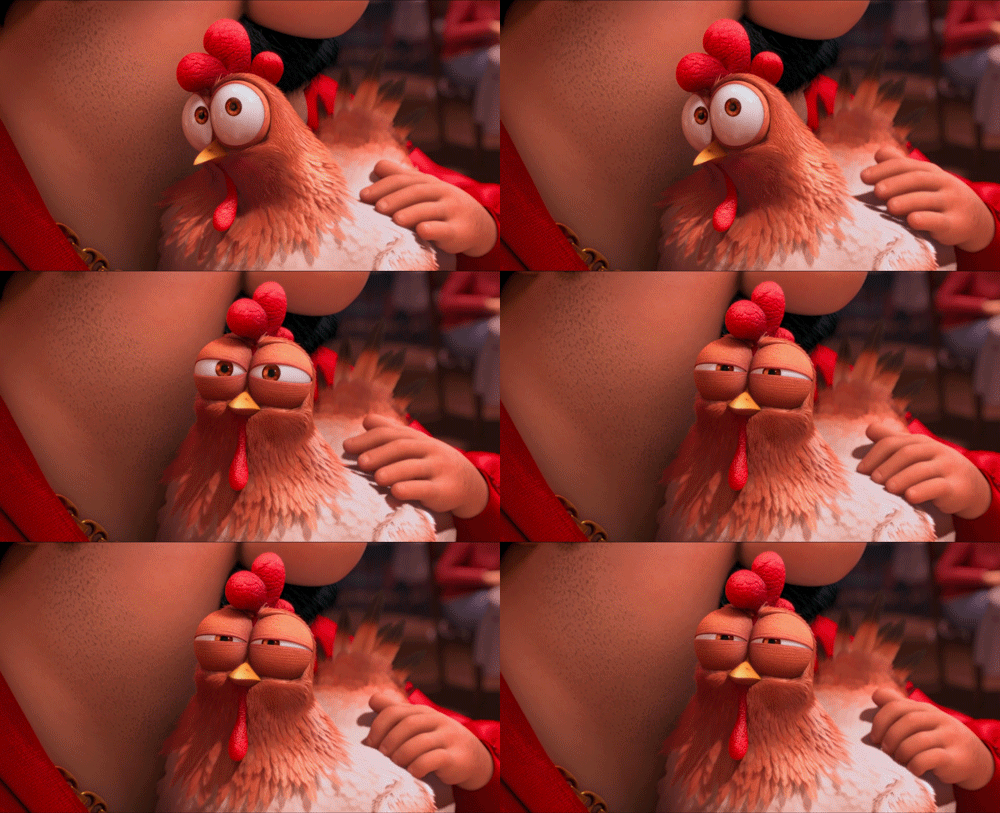 | |||
| "Are you having a baby...?" |
Luckily, the people at babynames.com know authors use websites like theirs for discovering names and have posted some tips just for us. I've picked some of my favourites to share with you.
"Ryder" is an English name that means Knight. Even if you haven't seen the movie, you can probably guess which role Flynn has.
Another great tip is to stay away from overused names. This is pretty straightforward. You stay away from certain names because everyone uses them. Baby Names use the name Jack as an example. "For some reason, every writer likes naming their hero JACK. I know it's a tough-sounding, honest-working name, but naming your hero Jack is like naming your son AIDAN. It's overdone".
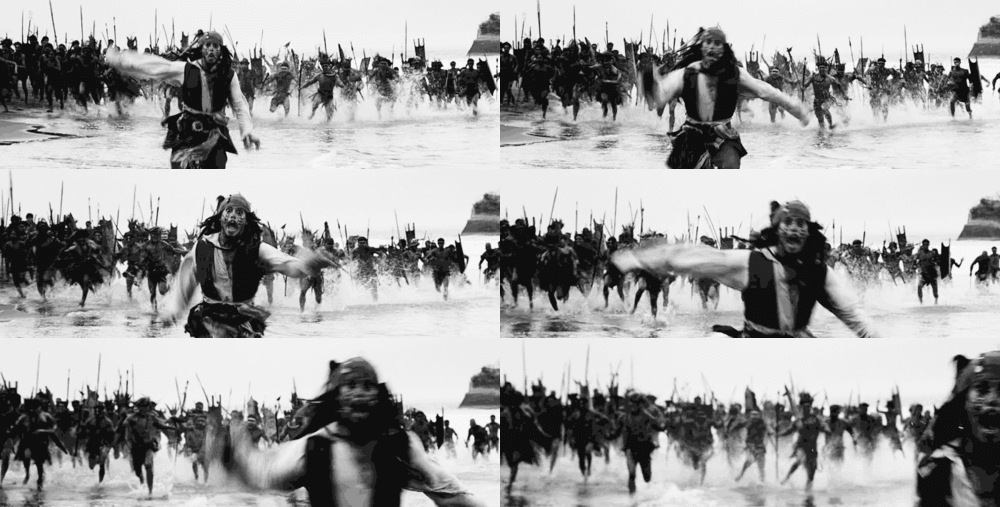 |
| That means you, Captain Jack! Run! |
The bottom line is to be more creative with your names.
I hope this abridged version of the tips from Baby Names give you a great place to start!
There are tons more on the list. Here's the link: http://www.babynames.com/character-names.php
If you're a sci-fi writer, be sure to check out #4!
Monday, February 17, 2014
How do you write a book proposal? Why might you write one?
 A book proposal is basically a marketing tool
similar to a business plan for your book.
This tool is used to get you a contract to write your non-fiction
piece. It does not require that you
already have the entire book already written, although it definitely won’t hurt
if you do. In fact, if you are a new author, an agent may ask to see the entire
book to be sure that you are capable of what you say you are.
A book proposal is basically a marketing tool
similar to a business plan for your book.
This tool is used to get you a contract to write your non-fiction
piece. It does not require that you
already have the entire book already written, although it definitely won’t hurt
if you do. In fact, if you are a new author, an agent may ask to see the entire
book to be sure that you are capable of what you say you are.
Many literary agents require a book proposal as part
of their submission guidelines. This is not to be confused with a novel
proposal, which is a different process.
Book proposals give the literary
agent key information which they will use to decide whether or not to contract you to
write the book and if the book is necessary. A properly constructed proposal will include
the following elements:
A
cover page and table of contents.
This is especially important if you are writing
something lengthy, such as a large textbook.
Overview
This section of your proposal will give a summary of
your entire proposal.
Target
Market
This section will be used to show you have done your
research regarding your intended audience and that the book you are proposing
is, in fact, marketable.
Competitive
Analysis
Here is where you give provide a list of similar
books by your competitors and tell the literary agent why YOURS is better. Do
not use this time to start flaming about how other works already available suck.
Author
Biography
Tell the literary agent in this section why you are
the best person to write this book and list your qualifications and areas of expertise.
Marketing
and Promotion Plan
Discuss how can help in promoting and selling your
book on your own. Only say what you are
actually capable of doing on your own without the publisher.
Chapter
Outline or Table of Contents
Briefly outline each chapter of the book.
Sample
Chapters
Include one or two strong chapters you’ve written
that best display why the literary agent should contract you to write it.
As your book proposal will determine whether or not
someone wants your book written, you must pay close attention to detail and
really put your full effort into its writing.
Most book proposals are fairly complex and take significant time to
write, often months. This is your time to show off
your sparkle and catch their eye; make your proposal the document that sells itself and your future book.
For further information on book proposals, please
see the following links:
Subscribe to:
Posts (Atom)