Thursday, December 11, 2014


                                     What's in a Name?


    "Nice to meet you wayward protagonist. Everyone around here calls me Grendel."

So you've got this idea for the next great Canadian novel, a truly staggering work of modernity that will change life as we know it and propel you to literary success. Before planning your Man Booker acceptance speech, you realize your entire manuscript is littered with gender neutral pronouns. After considering the potential of a post-modern masterpiece, you decide maybe it's time to go back to page one, and name some of these people.

But, but.. what about the fates of "Tall Child", "The Parent", and the beloved "Old Coot"? You're really telling me to delete all the "I's" in my first person narrative?

Well...yes.

Unless you have a really good reason for not telling us the names of characters, we're eventually gonna need some sort of identifiers to run with. By naming a character, we give it an identity; through identity we breathe life into the people/animals/hobgoblins in our stories. Remember that Heritage Moment? The one where Molly Johnson and Patrick O'Neill plead to keep their Irish names when they are adopted? The orphans want to keep their names because it's the only identity they have. Valerie Strauss of the Washington Post stresses the importance of what a name means to John Proctor in Arthur Miller's The Crucible:
As I pondered this on the way to work one morning, I remembered John Proctor in Arthur Miller’s “The Crucible.” Specifically, I remembered the absolute anguish of Daniel Day Lewis’s John Proctor from the movie version. Much is made, in literature classes, about Proctor’s refusal to allow Danforth and Parris to visibly show his name to the village as proof that he confessed.
To Proctor, his name is synonymous with his existence. Without a name he isn't worth "the dust on the feet of them that hang." This 'name' thing seems like a pretty big deal to the guy.

So by taking in consideration the power of names, it's important to choose one that's appropriate. If you decide to name your moon wizard "Jesus," your readers will be bringing their own connotations to your writing. Is this wizard going to do something that may or may not be like another famous Jesus? Your telling me that your space pirate is just coincidentally named Ahab? If you aren't ready to answer these questions, it might be best to stay away from really obvious established names.


                                       "No, you can't call me Yoshi."

Consider Joseph Heller's Catch-22. Yes, this is a guy that names someone Major Major, but also manages to have an incredibly unique name for his protagonist: Yossarian. I don't think I've encountered anyone other "Yossarians", and for good reason. It's a name that is wholly unique to the character, and would be more than a little off-putting to find someone named Yossarian in a spooky YA novel.

As writers, it is your job to make deliberate choices. Nothing should be coincidence or chance when you are creating, and the same goes for names. This was going to be the part where I go on a tirade about the meaning of characters names in Breaking Bad (Did you know Schrader is German for 'cutting off'?), but I'll spare you. What I was trying to get across through my tangent was that names brings into form the character we've created and define them, and are key components to storytelling. So if you decide to re-think your gender-neutral pronoun post-modern space opera, consider maybe calling your protagonist something like "Gregory."


Source:
The importance of a name (Washington Post)
http://www.washingtonpost.com/blogs/answer-sheet/wp/2014/09/19/the-importance-of-a-name/
(Yossi's April Congressional Mega-Article)
http://www.erepublik.com/en/article/-pcp-yossi-039-s-april-congressional-mega-article-2249841/1/20
What Would Jesus Do?. ethics,compassion,empathy,jehovah,watchtower,poetry,philosophy,atheism,animal rights 
http://smmcroberts.net/ethics/wwjd.html


Thursday, December 4, 2014

When Metaphor turns into Hyperbole

As someone who tries to be a writer, I feel like one has two specific jobs: first to have the dedication to get your butt in the chair to actually do the writing, and second to use requisite imagination and vocabulary to make a killer story.

Unfortunately, most people fall into two categories, people who have it the whole package and have their ducks in a row (they're so fly too, they're all classy, ducks, with tuxedos and crap), and people like me, who only fulfill one of the jobs. I am a pantser. I get stuck in the chair and I flop around like a dead fish with opposable thumbs gripping my pen with absolute despair. I wait and hope to the dear sweet muses that they sing me a lovely song. And soon.
                             ( Pictured here: a sad song of dali; even muses have budgets)

The problem that can sometimes happen here is when you finally get to your chair and you finally get a lock on what you're writing about you get excited ... too excited. Your descriptions are huge and cumbersome like a granny on a forklift, charging forwards for black Friday sales your sentences are over wrought. You might just kill someone.
See a metaphor, thanks to our trusted friend Wikipedia can be defined as “ a type of analogy and is closely related to other rhetorical figures of speech that achieve their effects via association, comparison or resemblance” that can be taken while not literally, as something that is closer to life .

“He's strong like an oak”. Yup, I get that he's not literally made out of an oak tree, but I know that his strength, while exaggerated could be preeety close to true.
But if we drag out our old friend Hyperbole, the sentence goes from “He's strong like an oak tree” to being “He's bulldozer strong with ten extra chainsaw arms and he breaths fire”.

 http://media.247sports.com/Uploads/Assets/445/12/1012445.gif
You're a bit too excited.

 I know that's a lie. Hyperbole can be defined as a deliberate exaggeration for effect that is not meant to be taken literally, like not one bit. A pretty common example you might hear often is “God, my backpack weighs a freakin' ton”. Yeah, man I feel you, its a heavy bag. But you and I both know that it does not in fact weigh a ton. That's the effect of hyperbole. Metaphor can be subtle and evocative, and hyperbole can sneak around, but it usually does so with lead plated boots and stomps around. Its an attention sook like that.
So, when you're writing, watch out, and pay attention to what sorts of rhetoric you're using. Sometimes hyperbole is the delicious frosting details that can make the scene or set the mood. Or, on the other hand, if your metaphor sort of hulks out into an ungainly beast that distracts everyone from your writing you've gotta cut it out. Take a step back and ask if you're maybe going a bit far.

Getting Into and Out of Your Genre Box


Ahh, genres. Say it with me folks: genres. 

Freaking genres.

Now, how to begin this lovely convo about everyone’s favourite literary tool, or device, thing, yes genres are indeed a thing – anyways. We’re going to begin by googling, y’know, as you do.

The Oxford Dictionary (the first result when you google a word when you’re writing an essay or looking up some word like esoteric when some jerk uses big words on you) defines genre as ‘a style or category of art, music, or literature.’  Oxford proceeds to provide information the origin of the word as coming from: ‘French, literally “a kind,” (see “gender”).’  So, whoa, all the more reason to wanna deconstruct the actual frig out of them.


(y'all know where it's from)

But, before we move on, for extra clarity Oxford’s less incestuous cousin, the Urban Dictionary, provides that genres can be defines as, ‘an unnecessary label attached to music, movies, novels, etc. giving way to discrimination, stereotypes, and prejudice.’

Yeah.

We can split genres a bit more: either into ways of defining genres within themselves such as romance, YA, Sci-Fi, or perhaps within literary context with examples such as poetry, scripts, and whatnot and forthwith. 

So literature (and other mediums) have genres within themselves; genreception meme-overkill, if you will.

Many will have come here with genres they are already at home with, and even if you don’t think you do, you do, and at least you’ll have friends and classmates you've known to have said things like, “Oh, I hate poetry, I’m a novelist,” or some other pretentious crap.

Anyone can make themselves at home in and out of (what, what – title drop!) different genres.

It’s merely a matter of experimentation (and you know everyone just loves experimenting).  You can blend genres really easy and much to your benefit.  For example, scripts provide a superb means of improving one’s use of and the believability of dialogue, so implementing it within say, a short story or even larger narrative piece, can yield beautiful results.


(from Marisa Calin's, "Between You & Me")


As for the genre-within-genre part, it’s way easier to change from something your familiar with – like, if you tend to stay within the mystical realm of High Fantasy – to a new, perhaps very different genre:  How hard would it be, my little fantasy friend, to implement your magic-y, sword-slinging cast of characters and implement them into a more mundane world?

Don’t answer, because we both know that careful deliberation or not, the truth is it really isn’t hard.  

While a genre can’t be a last second thought (ex. maybe don’t try turning your hard-core spacey sci-fi story into a ‘modern’ film noire right before publishing), it is something you can manage pretty dang well with a bit of thought and a touch of trial and error screwing around. 

You'd be amazed how easy it can be, and how absolutely freeing it is to find yourself working in a genre or medium you've never even considered before!

Young Adult with no romance, a grief story about death where you cut the death stuff out and make it work, a poem with no structure, mystery where motive isn't the question, BDSM erotica actually done well, fanfiction about historical fiction with your fav dead people plus your own cast! That slice of life story from your past turned into something new! 

Endless possibilities away you, my dears.

Well, even without delving into ideas such as the Sci-Fi Ghetto and the YA Market, hopefully you’ll have found this helpful, and if you did not I suggest coming back for a reread with a less clear mind and strong drink, taking a sip every time the word genre is used. I guarantee you’ll like it way more.

Okay, tatty-bye now loves.


Thursday, November 27, 2014

When are you done and HOW can you know it?

This is a common question that writers ask themselves, and guess what? It’s the easiest to answer:
YOU JUST DO.

Most people believe that when you’re writing a story or a book, or whatever it is, you’ll get to the last sentence of it knowing that it’s all about to end. They believe you’ll write this sentence with a sense of happiness and closure, glad to be finally done… But let me tell ya, most of the time (as to not say ALL THE TIME) this is not the way it works. Even after editing your piece one thousand times, to the point where you can almost recite it, there will always be more that you can do. However, like Anne Lamott would say, “You have to remind yourself that perfectionism is the voice of the oppressor.”


There’s always going to be that one character that you feel you could describe more, or make more interesting, or that one scene that you don’t know if it fits with the rest of the story. And how about you just make a few tweaks to whip it all back into shape... Every time you read your piece, you will find something that you could change because, as the author and creator of it, you’ll always see it as a work in progress. As your baby. And you might never feel 100% confident to put your pencil down and say “It is ready” but along the way, after having many others edit your piece, after taking these critiques and making something meaningful out of them, after personally going through it many, many times, you will get to a point in which something inside you will finally realize that you have done the best you can do for now and that its time to let go and move on to the next thing. And you’ll have to embrace this and learn, like a parent who’s leaving its child to nursery school the first day, that indeed, it is time. 

Choosing Your Voice or Finding Your Voices


            When it comes to writing any kind of story, the characters are the most important part. They keep the story going by acting it out. Without at least one character somewhere in the story, there isn’t much there to go on. Also, a character can be anything from the most well thought-out individual to a simple narrator with no form or gender.
            When it comes to deciding on your characters' voices, it can be tricky. Depending on what sort of person you want them to be, the way they speak needs to change. I will give examples of good and bad voices later on, but for now let's just agree that it would get very boring without distinct voices.
            When writing your story overall, try to think of yourself as a character. You are the narrator, and you must have a distinctive voice. Are you wise and all knowing, or are you just as lost as the rest of your voices?
            Younger characters in stories will not have a wide range of vocabulary like an adult would. For example a child would say “I like blue,” but an adult would be more likely to say “My favorite color is azure”.  Some characters will speak with a special accent. Pirates (not to be clichéd) will not sound the same as a refined gentlemen: “Arg matey,” versus “Jolly good sir”.
            Make sure that when you do finally find the voice you want to use, you stay consistent. It wouldn’t make sense for you two have two characters speaking and their voices switch halfway through. Also, as I said earlier make sure that your characters have different voices; otherwise no one will know who is talking unless you tell them.
            “Hey man, I got a question… It’s kinda important, so don’t laugh…”
            “Sure, ask me anything, I’m an open book. I would never laugh at you.”
            “What’s the best way ta pick up chicks?”
            “Just stay classy.”
            “For real?”
            “Yes.”

Plot: The Three Act Structure

When we talk about the three act structure, the first act is a beginning, the second one is a middle, and the third one is an end. Not all stories need to follow this rigid structure. Depending on the content of the story and the medium, it is sometimes best to do the unexpected. However, if you’re beginning to write a story and trying to figure out how it will play out, a three act structure is a good blueprint to follow. You can always change things later on and reverse expectations, I am just giving you suggested instructions for an early draft of your story. 

Act One: Beginning- This is where we have not yet left home and you have time to explain everything we need to know about the premise, setting, and characters so that you don't have to interrupt the action later on. Before anything happens, tell us who most of your main characters are, give us a little backstory, and have them explain their motivation that will drive the story. If the story will involve a character losing a precious heirloom, here’s where to tell us about that heirloom. If there are any subplots, this is the time to begin those. This is also the time to explain the events leading up to the first major plot point. At the very end of act one, the plot point that begins the story occurs. If the story is about finding a lost dog, the end of act one is when the dog gets lost. It is the plot point that entire the rest of the story revolves around resolving. 

Act Two: Middle- It is less clear what should happen in this act. Whatever needs to happen that isn't being saved for the end, use it here. Introduce any characters and subplots you couldn't fit into act one. Build up anticipation for act three. Make each plot point progressively more exciting and complex. Like act one, act two should be a series of events that lead to a major turning point that changes something about the characters, the setting, or the plot. Reveal a big secret or destroy a place, something that changes things and makes the reader have to find out how it ends. 


Act Three: End- This is the act that finishes the story. It should begin with the most exciting part, the climax. Sometimes it’s a big battle, sometimes it’s another challenge. It all depends on the story. The climax is the final confrontation in which everything else in the story depends on the outcome. After the climax resolves the main plot, resolve any other loose ends and subplots left over. This is only act that should not end with a major change. Rather than ending with the reader wanting to know what happens next, end with a sense that everything is finished and there is nothing more to tell. End on a satisfying note.

Thursday, November 20, 2014

Repetition Can be Great but Try Not to Repeat Yourself Too Much as Repetition Can be a Little Repetitive

Repetition can be a blessing or a curse. If used correctly, it can make a powerful theme radiate from your piece. Being a fan of repetition myself, I love using it in my poetrywhere can be used to bring life to a certain theme or idea that you really want the reader to focus on. Like a song's chorus, a repeated stanza in a poem makes you think that it’s there for a reason, that the writer wants that certain part read over and over again for a purpose. Whether it be for emphases, or because the particular stanza has information in it that pertains to the whole piece, repetition in a poem in particular almost always works, and if written well, flows quite nicely.


Prose generally tells a story in a much larger span than a poem. Stories need to be consistent, and therefor repetition is important in prose in the sense that you need to have a continuous theme throughout your story. This is done differently than in poems, however. The type of repetition that you see in poems can be quite tedious in prose. The style of prose is much more formal, and so repetition can become annoying, for lack of a better word. If you are describing someone or something and only focusing on one single detail and going back to it over and over again it can be difficult for a reader to move past -- such as continuously repeating words, as it just looks like nonsense.


However, if that sort of repetition is absolutely crucial to your piece, aim to repeat what you believe to be important in a poetic way, so that the reader doesn’t feel like they have to read what you’ve written, but want to, because it adds to the story. However, repetition can also be used for comedic effect, and therefore obviously does not need to written poetically. Just write it so that it's funny!


Repetition is a tool that can make or break your piece. Poems have less posture and are usually more free flowing; therefore, you can get away with a lot more. It doesn’t look as odd when you copy and paste that one stanza three times out of eight. It adds a different taste to your piece, makes your readers really think about what they are reading, makes them question as to why it is so important. In prose, repetition is important so that your story is consistent, and although more difficult to sporadically place well, it can be done. Just make sure to remember that if you are repeating something, ensure that it is dang important.

Thursday, November 13, 2014

Emphasising Emphasis in Writing


Firstly: A Definition
Emphasis: Vigor or intensity of expression.


                The above definition of emphasis is only one example of the meaning of emphasis, but in this limited posting it is the one that Kat will be talking about.

                It does not matter if a writer is a poet, a script writer, a novelist, a 6 year old writing a homemade card: apologising for the scribbles all over the wall because you thought that they looked pretty.

Everyone uses emphasis.   

                The two ways that Kat would like to discuss emphasis on this posting is as follows:

-Emotion
 
-Word Use

Word Use


                “Words, Words, Words” (Hamlet). If a writer wants a word or idea to stand out, then it must stand 
                                           
 Out

Words also can be redefined by how it is explained and shown:

"Madness can be a state of anger or ill temper or even a state of frenzied behaviour. However to Lewis Carroll author of Alice in Wonderland “We’re all mad here. I’m mad. You’re mad.”(Alice in the wonderland) 

So make sure to use the right emphasis to show which words are important.
Font

Font is an excellent way to communicate to the readers on what to focus on. This is also beneficial to the writer as well because you will know what your readers are focusing on. There is a reason one writes in Times New Roman when writing an essay: It transpires to the audience that you serious. 

                However, it can become confusing if a writer over does using fonts.
Q: See how many variations of fonts are in the next paragraph:

                Font is also an excellent way to communicate what you feel, but just like any artist you must know this one simple rule: What are you trying to communicate?

A: -5+ 14= ?  

However there is some good news, it is easy to correct and can be used productively towards your creative piece.  

The Dot


The most misunderstood dot of the English language. The dot is so much more than the end of a sentence. It is more than grammar punctuation. It is more than the space between
the final conclusion and The End,
and The End and the most frustrating after note: Next Book coming out in the Fall,

The point.

“you said you would never leave me

I know. I’m sorry. You have my whole heart. You always did. You’re the best guy. You always were. If I’m not here you can still talk to me. You can talk to me and I’ll talk to you you’ll see.

Will I hear you?

Yes. You will.” (The Road 270)
The Road has very little punctuation, but the thing it does have is the Dot.

Kat: Awww. The love is so powerful. Don’t you think that would be exactly what Mufasa would have said to Simba as his last words. If he had any last words to give? *hic*
Me: Get a hold of yourself, We need to get on with the Blog…
Kat:  Okay, Okay. I’m just a little emotional.
Me: We are going to be talking about that next.
Kat: -

Back to the Dot. It’s okay to keep your sentences short. It's alright if others want to wright this particular way too.
You want to wright like Hemming Way or Cormac McCarthy? Then make sure you are driving your point.


Emotion


Kat classifies emotion as a way to create emphasis.
Kat understands that this may be a bit confusing. When someone makes a piece or is reading a piece that there is never one line or two that make the point.
It is the combination that makes the point. One might also notice that this point of focus creates an image. 

They are dark,
creeping creatures,
Down
       The
              Wall.

Slouching carefully across dark floors
Or galloping through long grass.
Light only enhances the bony fingers
Gripping cane or stale ale.
They drip down between alley ways
Then
         Disappear.

They are as attached to you
As a lion to its mane.
It’s a proud voice that is the only one that laughs at your cruel jokes
And is the only one there
When you are awaking from the drunken sorrow,
Lying
       In
         Waste.

Hard concrete doesn’t stop it
From pasting its figure upon it.
The sun’s rays will not burn it
From the side walk.
It is the companion to men with no voice,
Sound
       Or
           Sight.(property of Kat VB)
The focus is obviously shadows, but the question is, how do we know this?

The art is to not get too distracted with the surroundings and the extra bits that carry the reader far from the point.  

These are the skeletons of writing and not the kind that slouch, creep, and grind through the pages. Using emphasis is the skeleton that stands tall and glares from empty eye sockets down at you with a challenging grin.  
Now ,go grab a pencil. Go grab some paper and leap out into the world and write. 


Comma Comas in the Punctuation Nation

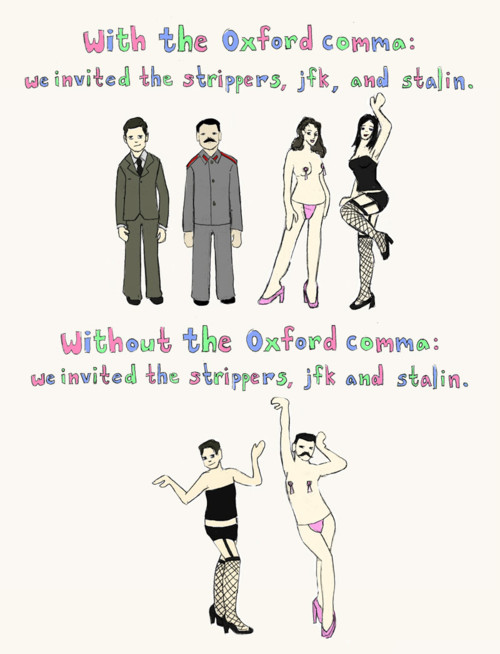
Welcome to the best and worst part about being a writer of any kind – commas. They're one of the greatest friends anyone could ask for but, in the same breath, they can tear us down as quickly as they build us up. Without commas at all, we would eat Grandma for dinner rather than share dinner with her instead. Without the Oxford comma, we would be inviting strippers, JFK and Stalin rather than inviting strippers, JFK, and Stalin; however, keeping this in mind, there can definitely be too much of a good thing.


We have the infamous run-on sentence. This is when a person begins to write about an idea, continues on with it and, just when it seems like the sentence is finally going to wrap up and finish, it continues, making the sentence extremely difficult to read and leaving the reader puzzled, bamboozled, and struggling for breath if they're reading aloud. This is a common issue with writers for we become so entirely enthusiastic about our writing, and who could blame us? Writing is an exciting thing and sometimes we simply get caught up in what we're saying, forgetting to pause and gather our thoughts.

Myself as a writer, I've found that – to avoid the terrible run-on – the easiest solution is to break up my sentences and use 'comma substitutes.'

Take the bolded sentence above for example. If we were to break it up in to chunks, the end result could transform the sentence into:

This is when a person begins to write about an idea. They continue on with it and, just when it seems the sentence is finally going to wrap up and finish, it continues. This makes the sentence extremely hard to read, leaving the reader puzzled or bamboozled. Above all, it leaves them struggling for breath if they're reading aloud.

Simple, yet effective; however, another option is to use comma subtitles – hyphens and semi colons as well as breaking up a sentence effectively – in order to destroy unwanted, run-on sentences. An effective example of the use of comma subtitles:

This is when a person begins to write about an idea. They continue on with and – just when it seems the sentence is finally going to wrap up and finish – it continues. This makes the sentence extremely hard to read, leaving the reader puzzled or bamboozled; above all, it leave them struggling for breath if they're reading aloud.


Using these tips and changing the flow of your writing, you’ll avoid pesky run-on sentences, saving Grandma, and leave JFK and Stalin off the pole.