Welcome to the best and worst part about being a writer of any
kind – commas. They're one of the greatest friends anyone could ask for but, in
the same breath, they can tear us down as quickly as they build us up. Without
commas at all, we would eat Grandma for dinner rather than share dinner with
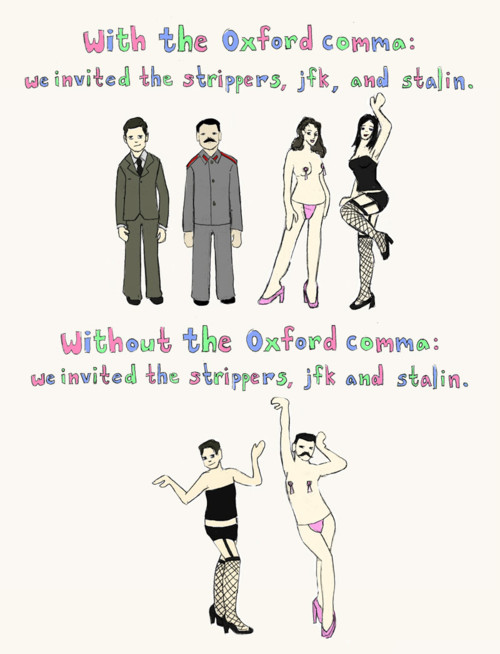
her instead. Without the Oxford comma, we would be inviting strippers, JFK and
Stalin rather than inviting strippers, JFK, and Stalin; however, keeping this
in mind, there can definitely be too much of a good thing.
We
have the infamous run-on sentence. This
is when a person begins to write about an idea, continues on with it and, just
when it seems like the sentence is finally going to wrap up and finish, it
continues, making the sentence extremely difficult to read and leaving the
reader puzzled, bamboozled, and struggling for breath if they're reading aloud. This is a common issue with
writers for we become so entirely enthusiastic about our writing, and who could
blame us? Writing is an exciting thing and sometimes we simply get caught up in
what we're saying, forgetting to pause and gather our thoughts.
Myself
as a writer, I've found that – to avoid the terrible run-on – the easiest
solution is to break up my sentences and use 'comma substitutes.'
Take
the bolded sentence above for example. If we were to break it up in to chunks,
the end result could transform the sentence into:
This
is when a person begins to write about an idea. They continue on with it and,
just when it seems the sentence is finally going to wrap up and finish, it
continues. This makes the sentence extremely hard to read, leaving the reader
puzzled or bamboozled. Above all, it leaves them struggling for breath if
they're reading aloud.
Simple,
yet effective; however, another option is to use comma subtitles – hyphens and
semi colons as well as breaking up a sentence effectively – in order to destroy
unwanted, run-on sentences. An effective example of the use of comma subtitles:
This
is when a person begins to write about an idea. They continue on with and –
just when it seems the sentence is finally going to wrap up and finish – it
continues. This makes the sentence extremely hard to read, leaving the reader
puzzled or bamboozled; above all, it leave them struggling for breath if
they're reading aloud.
Using these tips and changing the flow of your
writing, you’ll avoid pesky run-on sentences, saving Grandma, and leave JFK and
Stalin off the pole.

No comments:
Post a Comment