I've always liked writing. Ever since I was a little girl, I loved to write. Even if I wasn't writing, I was coming up with ideas and telling people about them. Part of it was because I liked (and still like to) be the center of attention, but another reason is because I want to change the world with my ideas. Perhaps not in a huge way, but in a I've-made-your-day-better sort of way.
For class, the article I chose to read was titled The Girl with the Ribboned Pigtails. The title really stuck out to me and was enough of a reason for me to read it. I thought it was going to be more about the impression that this little girl left on our author, Shauna Singh Baldwin, and how this little girl then influenced her to write. Rather, Shauna met this young girl with ribboned pigtails and was left to ponder how easily people now-a-days can become published.
That's what's to gain from this article as a writer in the 'real world.' Now that we have access to the Internet as well as everyone trying to make it big through the world of publications, she hopes that this girl with ribboned pigtails will continue to write, possibly get published, and make a living through the means of writing.
Those who write should write because they like to write. They should try to get published because they want to get published and feel as though their work is good enough. They shouldn't write "Only when [they] son't have anything more important to do." Writing is important. That's what's to be learned from this. Writing is the centre of our world and needs to be taking seriously.
Showing posts with label writing. Show all posts
Showing posts with label writing. Show all posts
Friday, January 30, 2015

Monday, January 26, 2015
Sean Michaels in a Creative Writing classroom

Sean Michaels doesn’t carry himself like A Great Writer. I doubt he
ever will, despite a writing life earmarked by incrementally greater achievements.
One Friday in January of 2015, he generously explained to students of Creative Writing Strategies the
process that resulted in Us Conductors, his first published novel and the 2014 Scotiabank-Giller prize winner. From a life
choc-a-bloc with familiar opportunities and idiocies, he picked out key choices
– most deliberate, but others that just happened along – which helped transform his public
self from high-school lit-geek, through renowned blogger, to literary
superhero. It was a typical list, told with atypical panache, and included:
- starting the music blog “Said the Gramophone” with friends while he was still in his teens.
- after a degree from McGill, deciding to work as a legal assistant, as a job that paid all right, but that he could leave behind at the office each day. A portable job; he worked in Edinburgh for a while.
- six years writing a novel.
- his blog getting the attention of editors at The Guardian; they hired him to do tiny, daily blurbs about the North American music scene. He quit the legal-clerical trade.
- finding the right agent – not too new, not too successful – by combing through the listings on Publishers’ Marketplace.
- re-editing the MS with her.
- her Sisyphean efforts to find that book a home, over months and months – the big US presses, the little ones, the big Canadian presses, the little ones.
- putting that MS in a drawer.
- watershed moment: deciding to start the next book, even though he’d just shelved an MS that represented seven-years’ labour without return.
- writing the next MS.
- sending it to his agent. This time they started in Canada, and several big presses were interested.
- negotiating a largish advance, for the current Canadian market. (Still, it broke down to something just over $5000 per annum for the years that he wrote it, not including the time spent learning his craft with the first MS.)
- editing, again, some more. With his agent, with his workshop group, with the big Canadian press, and with the little American one. At one point there were six people giving him feedback on the MS.
- publication!
- and now, the Scotiabank-Giller. When we saw him, he was on his third week of not having to write for The Guardian.

Thursday, November 13, 2014
Comma Comas in the Punctuation Nation
Welcome to the best and worst part about being a writer of any
kind – commas. They're one of the greatest friends anyone could ask for but, in
the same breath, they can tear us down as quickly as they build us up. Without
commas at all, we would eat Grandma for dinner rather than share dinner with
her instead. Without the Oxford comma, we would be inviting strippers, JFK and
Stalin rather than inviting strippers, JFK, and Stalin; however, keeping this
in mind, there can definitely be too much of a good thing.
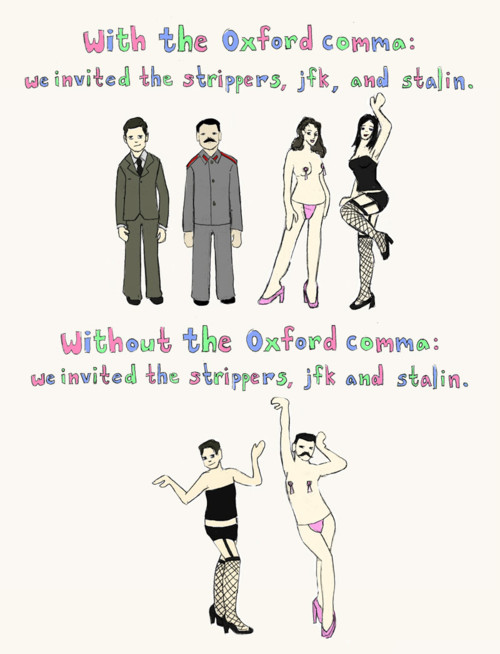
We
have the infamous run-on sentence. This
is when a person begins to write about an idea, continues on with it and, just
when it seems like the sentence is finally going to wrap up and finish, it
continues, making the sentence extremely difficult to read and leaving the
reader puzzled, bamboozled, and struggling for breath if they're reading aloud. This is a common issue with
writers for we become so entirely enthusiastic about our writing, and who could
blame us? Writing is an exciting thing and sometimes we simply get caught up in
what we're saying, forgetting to pause and gather our thoughts.
Myself
as a writer, I've found that – to avoid the terrible run-on – the easiest
solution is to break up my sentences and use 'comma substitutes.'
Take
the bolded sentence above for example. If we were to break it up in to chunks,
the end result could transform the sentence into:
This
is when a person begins to write about an idea. They continue on with it and,
just when it seems the sentence is finally going to wrap up and finish, it
continues. This makes the sentence extremely hard to read, leaving the reader
puzzled or bamboozled. Above all, it leaves them struggling for breath if
they're reading aloud.
Simple,
yet effective; however, another option is to use comma subtitles – hyphens and
semi colons as well as breaking up a sentence effectively – in order to destroy
unwanted, run-on sentences. An effective example of the use of comma subtitles:
This
is when a person begins to write about an idea. They continue on with and –
just when it seems the sentence is finally going to wrap up and finish – it
continues. This makes the sentence extremely hard to read, leaving the reader
puzzled or bamboozled; above all, it leave them struggling for breath if
they're reading aloud.
Using these tips and changing the flow of your
writing, you’ll avoid pesky run-on sentences, saving Grandma, and leave JFK and
Stalin off the pole.
Wednesday, November 5, 2014
What to Leave Out
“Leave out unnecessary details, unnecessary words, and things that you know nothing about.” This is what I was going to write in this blog post before I decided I didn’t want it to be boring and cliché.
Instead, I believe that there is a loophole in the topic that could take us somewhere interesting. “What to Leave Out” automatically makes us think about what to physically leave out of our writing. But what about the things that we should mentally leave out of our writing? In a lot of ways, the attitudes that we adopt have as much influence on our writing careers as our writing itself.
Everyone has their own personality and their own way of doing things, of course, but we do live in a culture where self-improvement is trendy; so, on that note, let us begin!
1. Leave Out Laziness
Nobody’s going to do your work for you, and nobody’s going to succeed for you. A creative career rarely happens by mistake. It requires strategy, diligence and inspiration. These things are interconnected, and I would say that all three are required if you want to reach your potential, but if you’re lacking in one of these areas (even just temporarily) the other two can likely still make a productive writer out of you. Yes, strive for all three, but don’t be discouraged when you’re not perfect (which brings me to my next point!).
2. Leave Out Pride
Pride is something that a lot of writers struggle with. This is not to say that a certain amount of pride should not be taken in one’s work, but it is important to keep an open mind and remain teachable. Thinking that your word is law is perfectly acceptable until you come across someone who actually knows better than you do. Receiving criticism from a place of humility is a lot less painful than having your pride hurt when you end up being wrong.
3. Leave Out Jealousy
Writing is a competitive business. Some will succeed, some won’t. It’s just like becoming a doctor, except more challenging. However, one thing that some writers (and people in general) do not realize is that jealousy is rather pointless.
First of all, it does not make you a better writer. Sure, seeing somebody else succeed can be a good source of motivation, but said motivation does not have to come from a place of negativity or jealousy. They should not be blamed for their success any more than you should be blamed for yours.
Secondly, some aspiring writers do not realize that when their comrades succeed, from that point on they know someone in the business. Instead of forming relationships and connections with their peers, they burn all of their bridges (or even neglect building them in the first place), which leaves them stranded alone on an island with no writing career and a whole lot of resentment.
 |
| He is not having fun! |
Thursday, October 30, 2014
Nevermore (Starting over again)
It
is an action most writers like to avoid, but sometimes it's necessary.
Starting over in any writing piece is both daunting and relieving. Maybe the
beginning of the story just doesn't hit the mark or the tone you wanted
throughout is not being expressed, making changes is okay.

We
all start out with a first draft and usually whatever actions that happened in
that first draft are more than likely different to the final product. Revising
and well starting over again is a challenge, but it is a challenge which will
pay off in the end. Going back and changing the formula to a story is a big
difficult step and that’s probably why so many writers have trouble doing it.
There might be a character you have created which you just love, but maybe the
character doesn’t belong in the story. Changing the character will be difficult or
removing them from the story is even harder. Those are the kind of choices we
have to think about when writing.
To
avoid starting again making a more detailed outline for characters and the storyline
can be made and where the basis of the plot is more concrete. Having an
outline can just let the chances of starting over again be a low one, but as
far as it goes starting over is unavoidable. Maybe the idea is in your head, but
putting it to paper is not coming out the way you want it to. It happens and
that is fine, also it is better to note down your thoughts than let them run
loosely in your head. 
“I
have files, I have computer files and, you know, files on paper. But most of it
is really in my head. So God help me if anything ever happens to my head!” –George
R.R. Martin
Making Memorable Characters
What’s this I hear about you wanting to make a memorable character? What have you got? Wait…wait did you say…a cynic who actually has a heart of gold? The books will literally fly off the shelves into people’s hands at that point. You also have a brooding bad boy; why are you only just now telling me this? Put him there next to all the others.
Cut.
Print.
Bestseller.
Enjoy the limelight, there’s a cocktail party at my house later.
It’s unfortunate that we live in the literary apocalyptic wasteland that is 2014, where just about every character archetype has been done to death and has faded into cliché. It forces up and coming writers to ravage the carcasses of other characters just to make their own, stitch two together and call it a new one. Think of it like Mad Max, except everyone’s a more financially successful writer than you are.
 |
| There he is kids. The sweaty, bloodstained author of The Maze Runner. Don't look it up; just take my word for it. |
Everyone wants their characters to have impact. On a smaller scale, we want them to mean something to somebody. We want our audience to laugh when they laugh, to cry when they cry or for the very least, feel for them as they do so. On a much larger scale, we want them to be remembered. We want what they say and what they do to transcend generations. We want to put pen to paper and scribe the next Tyler Durden but we live in world where we try so hard to be original that we forget all about the execution. You are Jack’s conscientious use of recycling.
Sorry to say, that we can’t make the next new character because they’ve been updated and reused time and time again. Instead of conveying originality to your readers, you should be convincing them that the people they’re reading about have a beating heart. Your character needs to know joy, they know to sadness, defeat, envy, hatred, loss. This is less about making something new and more about making something believable.
Put your brooding bad boy under the spotlight. What scares him? Who does he love? What does he love? Go shopping for your character: what does he wear? Where does he shop? Put him in situations:
- A job interview.
- A first kiss.
Make him succeed, make him fail. Each response will resonate as your own, these simple quirks and traits that make your character real and believable. Rinse and repeat with your cast, of course you’ll go into more depth depending on their significance to the plot- so what you do with each will vary. A different take on something familiar allows you as a writer to make the best of what you know. It convinces your audience that there’s still millions of ways to breathe life into something that’s been done time and time again. It’s not about making your character compete with greats, it’s about making them your own.
Narration: Truth or Dare?
Every
story has a narrator – a voice or view that is expressed.
Whether it’s from first, second, or a third person perspective, a story
generally follows characters through a series of events. These events are told
to us, the outsider, and allow us to live vicariously through the characters
experiencing them.
But have we ever stopped to ask if we should believe in our narrator?
If you've seen the films Fight Club or American Psycho, then you are aware that relying on the main character’s perspective does not always result in the story being told truthfully. The audience is lead to believe one perspective is factual, but it is later revealed to be false. This is what we call the unreliable narrator – one whose view is anything but credible.

(See
above film, it’s fantastic)
There are other films that use the unreliable narrator and tell you point blank that you might want to keep an eye out on this plot because it’s going to get weird, really fast. This includes mind-benders like Inception, Pan’s Labyrinth, or The Grey. The audience isn't told what happens, but is instead left with an open ending. This is basically a slap in the face, a taunt to the audience, and the cruellest effect of unreliable narration. You may drive your audience insane with the need for justice, but you will have succeeded in creating an unforgettable tale. You need to make your audience believe one thing and then be left with questions such as:
Wait, so did she create this all or was it true?
Is that wolf breathing or is he under it like in that Disney movie, Tarzan?
Maybe you don’t want them asking that last one, but you get the point. You as a writer are to be the puppet master. The audience is Little Red Riding Hood and you are the Wolf in Grandma’s clothes. They are the spoiled prince and you are the ugly witch that is going to curse his ass if he doesn't pay attention. Now fly, my pretties, and be the devious narrators we were all meant to be. After all, who has fun being reliable, anyway?
Friday, October 17, 2014
Some Inspiration on Inspiration
Even as I sit here now, the white screen staring at my face is overwhelming. As writers, one of our biggest challenges is self-discipline. This isn’t an attempt to suggest which ideas are worth writing about; this is about expanding those ideas. How do we find the inspiration to focus our minds and energy on turning a blank slate into a novel, a poem, or script?

Another important aspect to maintain that steady flow of writing is to get your ideas out in the open. There’s a popular opinion that writers confine themselves inside coffee shops and studies in order to pound out full manuscripts, but this isn’t the case. Workshop groups are a great way to get opinions on your work from fellow writers. It’s important to know what’s working in your piece and what isn’t, and the best way to figure this out is to allow it to be read and let your readers tell you. After all, they’re your primary target. Let them be the judge as to what needs work, and they’ll assist in deciding which direction the writing should go next.
Finally, and this may require a development of character, look at the world as a source for creative breakthroughs. Inspiration is all around us once we slow down enough to search.
“I’m not saying this is anything like perfect in practice, but if I can approach my life with some kind of interested enthusiasm then it can become inspirational.” - Al Kennedy
Ultimately, your own experience has given you the material you need to create a manuscript that you can be proud of. Look into your own life to drive the inspiration for your writing; there’s more in there than you’d think! Take pride in your work and don’t be afraid to share it, and soon that blank computer screen will become something great.
~ Devon Palmer
Subscribe to:
Posts (Atom)