Sunday, March 29, 2015

Lesley Choyce, All Alone at the End of the World: Poetry Review

 Lesley Choyce’s latest collection of poetry includes pieces both anecdotal and philosophical. All Alone at the End of the World gives readers the sense that they are not alone at all, but sitting with an experienced storyteller who leverages his unique voice to make the poetry fly off of the page. Using wit and sharp diction, the speaker spins tales of the mundane into larger-than-life adventures that ensnare the attention of the readership.
Choyce has the capacity to create tangible imagery, vividly translating his lived experiences onto the page. Readers feel their hearts race while reading “Black and White Cat on Oxford Street,” a poem that is not profound in the subject that it treats, but which powerfully creates fear and then relief:
The cat is, I swear
in flight,
its trajectory taking it
straight into the grill of my car
when suddenly
it understands the density of its disaster,
angels grabbing at its claws midflight,
flipping it backwards
onto the safe hard comfort of the curb (19) 
With technical prowess, Choyce uses line breaks and enjambment to generate suspense, while alliteration highlights the main events of his colloquial story. The poet’s retelling makes an extraordinary poem out of an ordinary event.
All Alone at the End of the World transports readers to Halifax, Nova Scotia, and then takes them around the world. Building on themes of the universal, Choyce’s book is infused with philosophical poems that pull his readership out of their current surroundings, and invite them to join him on his journey of self-reflection. For example, he recognizes the complexity of identity in “Contradictions”:
This poem is not helping
To solve the threadbare mystery
of me, however,
and my desire to be here and now
but also scattered everywhere
and anywhere at once.
This is an ambitious poem
going nowhere. (21)
Building on a common issue, the speaker’s inability to solve the “mystery / of me” conjures a sense of empathy from readers. Mirroring the role of a mentor speaking to an acolyte, Choyce’s narrative relays a message reminiscent of Rainer Maria Rilke’s Letters to a Young Poet:  “. . . be patient toward all that is unsolved in your heart and try to love the questions themselves like locked rooms and like books that are written in a very foreign tongue” (34-35). The playful tone creates the sense that the speaker accepts that his desire is unsolvable, even before stating that the poem is going nowhere; Choyce embraces his contradictions, and inspires others to do the same.
          Choyce’s All Alone at the End of the World finds beauty in seemingly monotonous aspects of life and encourages readers to look for splendors often taken for granted.


Works Cited

Rilke, Rainer Maria. Letters to a Young Poet. Trans. MD Herter Norton. New York: WW Norton & Co., 1993. Print.

by Benjamin Lord, with input from Monica Grasse, Sharisse LeBrun and Molly Strickland


Friday, March 27, 2015

Censorship


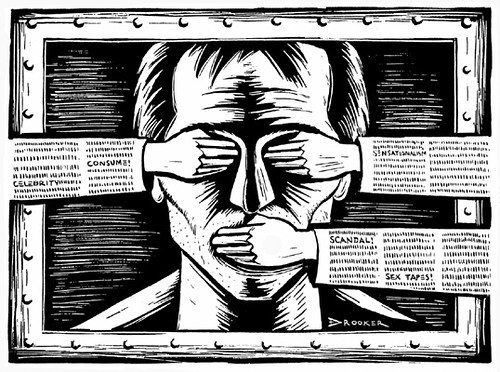
Remember reading Ray Bradbury’s Fahrenheit 451 or The Diary of a Young Girl by Anne Frank in school? These are just two famous books censored for their content and watered down to fit the standards of the education system. 
While some books don’t seem to be problematic to audiences, others might find problems and feel the need to ban it. In one famous case, some religious groups wanted to ban J.K. Rowling’s Harry Potter series. These groups claimed that it glamorized witchcraft and would influence their children’s minds. I think they forget the fact that it’s a fantasy book. The rally to ban or censor books just makes it easier for parents and teachers at school to avoid having a proper conversation about literary content. 

Books are here to generate discussion about culture, race and sexuality. It provides a platform to discuss history as it goes along with its literary content. In Mark Twain’s The Adventures of Huckleberry Finn, racial slurs are used frequently. 

Recently on a television show there was a discussion about whether they should ban Twain’s novel in Canadian classrooms. On one side people found that banning the book would not influence children to use racial slurs. On the other side people thought that reading the book would allow a discussion about the historical context and racism during the time.

Trying to ban books isn’t anything new. Back when Nazis occupied countries, they burned books and got people to do so too. Book burning events were there to keep people from reading novels which had ideas against the Nazi regime. With book burnings happening more and more back then, some history got lost and independent thinking went with it. 


To ban and censor books is a dangerous action. Whether a book has too much offensive language or has sexual content that doesn’t fit the heterosexual norm, it doesn’t mean that it should be watered down. Novels shouldn’t be censored or banned, instead it should be read and discussed with students. Teachers should generate discussions on the past history and how it connects to the book. Censorship hurts both the writer and the reader when content is deemed too controversial. Otherwise, banning books erases the history that goes with it and without talking about it, ignorance follows.

Tuesday, March 24, 2015

Wattpad: Social Networking for Writers


               “Whatever you’re into, it’s all free on Wattpad: the world’s largest community for readers and writers.”

Whether it is poetry, fanfiction, script, excellent or awful—anything you can write can be uploaded for the world to read on Wattpad. Wattpad is an Internet platform that allows writers to upload their work for the reading pleasure of other users.

Professional writers use often use Wattpad as a tool for engaging new readers—getting new people interested in what they’re writing as they’re writing it, before taking the content down and having it professionally edited and released as a book. This allows writers to give potential new readers a taste of their style and have them waiting, and sometimes asking for more, or send them looking for other work that they have written. However, Wattpad is open to the work of anybody willing to upload it, whether or not they are professional writers.

As the tagline may suggest, Wattpad is a very large online community and receives upwards of 200 000 uploads of writing on any given day. That’s a lot of writing, and it’s easy for one post to get lost in the slew. That’s why it is important to remember that Wattpad is essentially a social media platform, and that reciprocity is important in making sure that your writing gets noticed by other people. Wattpad allows users to submit feedback to any posts they read, which the author can see and respond to. This is a great way to attract attention to your own writing, as well as encouraging others in their own work. As I said, “reciprocity” is an important factor: usually, if you read another person’s work and offer feedback, there is a greater chance that that person will give some of your writing a read and offer you feedback as well.

Wattpad implements the “followers” system, which allows users to be notified when an author they follow posts something new. Every time another user reads your work, the counter of “reads” goes up and gives your work a greater chance of being noticed by new people, which in turn allows for a greater chance at obtaining new followers.

Mary W. Walters (author of Rita Just Wants to Get Thin) describes Wattpad as “a humongous writing group where no one has to make coffee or serve beer, [and] I don’t need to get dressed before offering feedback on other writers’ works.” Whether you’re interested in promoting your work or simply receiving feedback, access to the world’s largest writing community is only a few clicks away.

SourceWalters, Mary W. "Wattpad: Engaging Readers as You Write." Write (2014): 19-21. Print.

Friday, March 13, 2015

Review: Susan Paddon’s "Two Tragedies in 429 Breaths"

“When you could still speak, // the last thing you were able to ask me / was where all of your worry would go” (93). In her debut book of poetry, Two Tragedies in 429 Breaths, Susan Paddon shows us just where the worry goes; she provides readers with a poetic narrative that explores the links between the deaths of her mother and Russian writer Anton Chekhov. In this moving memoir of her mother’s life, Paddon sheds light on traumas affecting us all: death and loss.
            While Paddon clearly draws similarities between the two tragedies, what is most telling is the significant difference. In researching Chekhov, Paddon found that “no one made confetti of his personal life” (34). His sister and caretaker Maria was privy to the more private details, “stories she could never get clean” (39). On the other hand, Paddon struggles with her mother’s insistent editing of her own life in her refusal to share her stories and memories with her daughter. Poems such as “Albuquerque, New Mexico” emphasize this tension when Paddon discovers a photo of her mother in her 20’s in bed with an unidentified man:
            And there is a girl with you in the room. She is the one who has 
            captured you both in the shot. Her camera and reflection in the
            mirror. It wasn’t like you to get caught.

            It’s strange I care so much about who they are or whether or not you
            loved him, or if he was good to you, your twenty-something self.
            This photo doesn’t belong to me. I just happened to find it
            among your private things. (114)
            Paddon’s desire to make sense of her own tragedy through allusions is reminiscent of J.J. Steinfeld’s preoccupations in Identity Dreams and Memory Sounds. However, unlike Steinfeld—who remains stuck in his family’s trauma—Paddon anticipates how she is going to incorporate her suffering into her existence in a way that does justice to her mother’s memory, but allows her to move forward: “Yes, I will go on. Yes, I will get better/ and throw myself into things. I will, on occasion, take pills to breathe” (109).
            What is perhaps most impressive about this book is how well structured it is. By dividing the book into seven sections—the months of April through September and a final section entitled “After”—Paddon creates a linear chronology that allows the reader to navigate the complexity of her lengthy book. In contrast, the repeating epigraphs from Chekhov to Maria or his wife Olga, his letters from Yalta, and Paddon’s own “Unsent Letters” throughout the book, all demonstrate the cyclical nature of time, emphasizing the book’s themes of life and death, remembering and forgetting.  
            The poems in the book and in individual sections are very carefully placed, as each juxtaposition sheds light on the poems involved. We find an example of this in Paddon’s answer to her mother’s final question, “Where will all your worry go?” (93). In “The Minister’s Visit,” the neighbor Leona, upon discovering the death of Paddon's mother
                        …cries
            for everything bad that has ever been.
            Not because this loss
            is so great, but because loss
            is a reminder of other losses. (96)
This poem is immediately followed by a letter from Chekhov (but also Paddon) to Maria that repeats the phrase “I know where the worry goes” (97). Paired with “The Minister’s Visit,” this shows us that the tragedies of Paddon’s book are not just personal, but affect us all. The ability to evoke such strong reactions through the “reminder of other losses” (96) demonstrates Paddon’s storytelling abilities and is indicative of a strong, successful writing career to come for this debut poet.

Works Cited
Paddon, Susan. Two Tragedies in 429 Breaths. London: Brick Books, 2014. Print. 
Steinfeld, J. J. Identity Dreams and Memory Sounds. Victoria: Ekstatis Editions Canada Ltd., 2014. Print. 

by Sharisse LeBrun, with input from Monica Grasse, Ben Lord and Molly Strickland


Wednesday, March 11, 2015

Thinking Outside the (Big) Box (Stores): A Surprising Alternative to Traditional Book Shops

"Local bookstores are dying!" is the common refrain from many in the publishing industry. In fact, Tyler Lifford wrote a blog post on the topic a few weeks ago. With more and more local bookstores reducing their stock or outright closing, authors are feeling the pinch. So what can you do when your potential market starts shrinking?

Simple: start looking for other markets.

Specifically, gift shops.
The Entrance to the Hong Kong Science Museum gift shop
 Museum gift shops are a viable option particularly for non-fiction authors whose subject matter falls nicely in line with a museum or historic site’s interests. For example, the Canadian War Museum in Ottawa (obviously) stocks war-related books. Depending on centennials or bicentennials, the museum will target works on specific topics, such as the War of 1812 during its recent bicentennial. While museums mostly focus on non-fiction works, fiction and poetry related to exhibits is occasionally sold from gift shops as well.

Stocking books in museum gift shops can also serve as a springboard for future marketing opportunities; in Kristin Eckstein’s post “5Profitable Places to Sell Your Book,” she mentions a student who not only successfully sells books to museum gift shops but is also invited to book signings and lectures at other museums, which increase the likelihood of making sales.

You might scoff at the idea of gift shops as a potential alternative to local bookstores. “Sure, some stores might stock books, but nobody goes to a museum to buy books,” you might say. However, that ignores the fact that 60 million people visit the 2000 museums that are part of the Canadian Museums Association (the total number of museums in Canada exceeds this).

So consider this; thousands, potentially millions, of visitors care enough about a specific topic (war, art, science, etc.) to go to a museum dedicated to that topic and browse through the inevitable gift shop that lies between them and the exit. They see a biography of their favourite war hero or a book about Canadian Aboriginal art and then BAM! sale. Most visitors to your typical bookstore, including big box ones like Chapters-Indigo, aren’t as likely to have even a basic interest in such titles as museum visitors. Plus, gift shops don’t stock nearly as many titles as a traditional bookstore, meaning that your book (assuming it gets put on a gift shop’s shelves) would have less competition than in a traditional store.


Selling through a gift shop certainly won’t make anyone a New York Time’s best seller, and is a bit trickier for fiction and poetry authors. However, for non-fiction or even fiction with a specific interest and/or a niche market, you might want to start thinking about getting in contact with those museum gift shops.

Tuesday, March 3, 2015

Shoshanna Wingate, Radio Weather: Poetry Review


In her debut book of poetry Radio Weather, Shoshanna Wingate finds beauty in the dark aspects of life and dark undercurrents in life’s beauty. These contrasting aspects permeate Wingate’s storied memories, indicating her belief that “Our stories, .../tell us who we are” (12).

       Wingate’s book creates a sense of home by paralleling childhood’s innocent discovery of the world with adult ponderings about life’s meanings, cruelties, and beauties. The concept of home is developed in “Secret Garden,” as the author discovers that her home is not the “cookie cutter kind,” but something “living,” that contains a personal history (35).  Wingate also achieves an understanding of home by accessible, conversational language, reminiscent of the simple yet profound diction in Judy Gaudet’s Conversation with Crows. Both collections treat topics deep and everyday with clarity.

As the poems move from childhood into adulthood, a sense of anxiety arises. A feeling of entrapment is evoked in Wingate’s long found poem, “Letters from Vietnam.”  These are excerpts from soldiers’ letters addressed to Wingate’s father, who counselled them on becoming Conscientious Objectors, thus making Wingate two steps removed from the trauma of the Vietnam war. Wingate uses “Letters from Vietnam”’s journey from ambiguous identity to desperate pleas for hope as a parallel for her own upbringing; despite one letter’s wish for the recipient to “raise/your child with peace in mind,” (46) she remembers a her father as a man who “doesn’t speak what you want to hear” (52).

In “AIDS Ward” Wingate continues to carefully craft entrapment by taking advantage of language’s multiple meanings as a result of enjambment. Broken lines create both resentment and sympathy for the relationship between Wingate and her father, and her father and his illness:  

This is the daughter untying the strap
        that restrains the man that lies

        in an empty room where he is dying
        on a floor full of rooms, emptying (53).

Shoshana Wingate
This creation of the feeling of claustrophobia is similar to that of J.J. Steinfeld’s Holocaust memoir Identity Dreams and Memory Sounds, where focus is given to individual identity, memory and dreams. However, Wingate’s ability to overcome the “dark…shadows,” (34) allows her to enjoy the promise that everyone – including herself – can find themselves “content in/knowing what we’ll find when we awake (59).

Radio Weather’s heartbreakingly honest stories move past moments of struggle to bring together various stages of life, love, death, and hope. Shoshanna Wingate’s “common language” (pace Wordsworth) considers beauty’s darkness, presenting readers an attainable hope found in the comfort of recognizing home.


Works Cited

Gaudet, Judy. Conversation with Crows. Toronto: Oberon Press, 2014. Print.

Steinfeld, J.J. Identity Dreams and Memory Sounds. Victoria: Ekstatis Editions Canada Ltd., 2014. Print.

Wingate, Shoshanna. Radio Weather. Montreal: Véhicule Press, 2014. Print.


by Monica Grasse, with input from Ben Lord, Molly Strickland and Sharisse LeBrun.

Thursday, February 26, 2015

Being a Writer in the Internet Age

             
One of the biggest dreams any writer has is to be published and have their work read by the masses. It’s a beautiful dream, but one that often is not realized because of how difficult it is to be discovered. On top of that, publishers are so picky when it comes to what they will and will not put their faith in. Going through the process of finding an editor, putting your soul into the pages you have written, only to be turned down by every publishing company you contact? It can be devastating.
Being a writer in the modern age has advantages as well as disadvantages. It is making getting our foot in the door easier, helping new talent be discovered, and helping to broaden our horizons by showing us the other great talents that are out there. Thanks to the internet we can be the writers, publishers and agents of what we choose to create. Bloggers for example have all that they could ever want. They write what they enjoy, publish it, and their followers read it. Publishing a book is much more difficult, whether online, paperback, or both, but thanks to online writing forums, young writers are being noticed faster than they once were.
                The greatest disadvantage to living in a world where writing is now online is the fact that people really are not buying books as much as they used to. People have begun to torrent books, just like they would with a movie or a CD. People do not stop to think about the impact this has on a writer, especially one that is new to the published world. It is a harsh place, and a writer will not make money if their product does not sell. A writer can be known world-wide and still be starving if their book is only being stolen and not bought.
                If the authors are not making money, then the publishers are also not making money. If publishers are not making money, their desire to publish us will eventually disappear, and then where will we be? We could be right back where we started, or perhaps worse off than before. Perhaps nothing will be published in the future, because there is no market for it. Piracy has moved from music, to movies, and now it is attacking publishers, our starving artists.
                The only chance young writers have of making it big is if everyone continues to give their full support to the writing community by buying books and continuing to pursue their dreams of making it big.